In short
- HFT is a kind of algorithmic trading where computers place and cancel very large numbers of orders, holding positions for seconds or less.
- Its edge is speed: servers next to the exchange (co-location), fast data feeds and tuned hardware.
- Common HFT activities are market making and arbitrage, earning tiny amounts many times.
- Retail traders cannot compete on speed, and do not need to. Rules, risk and patience are where you can have an edge.
Every time you place an order, there is a good chance a computer on the other side answered it faster than you can blink. That computer most likely belongs to a high-frequency trading firm. HFT is one of the most talked-about, and most misunderstood, parts of modern markets in the US, India and elsewhere.
This guide explains HFT in plain words: what it is, how it works, the strategies behind it, the controversies, and what it means if you are learning to trade.
HFT in one sentence
High-frequency trading is automated trading that relies on extreme speed to place, update and cancel orders, usually holding positions for very short periods and ending the day with little or no open position. All HFT is algorithmic trading, but most algorithmic trading is not HFT.
Why speed matters so much
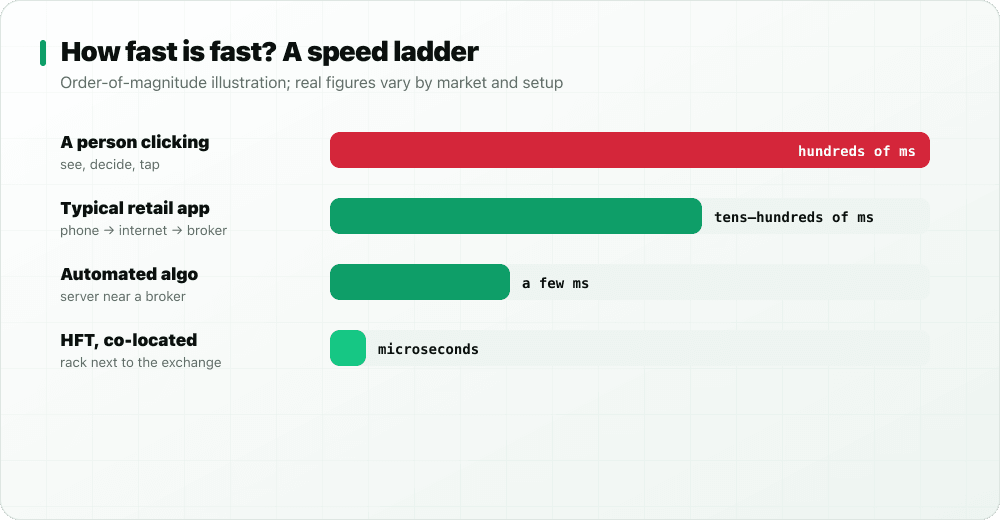
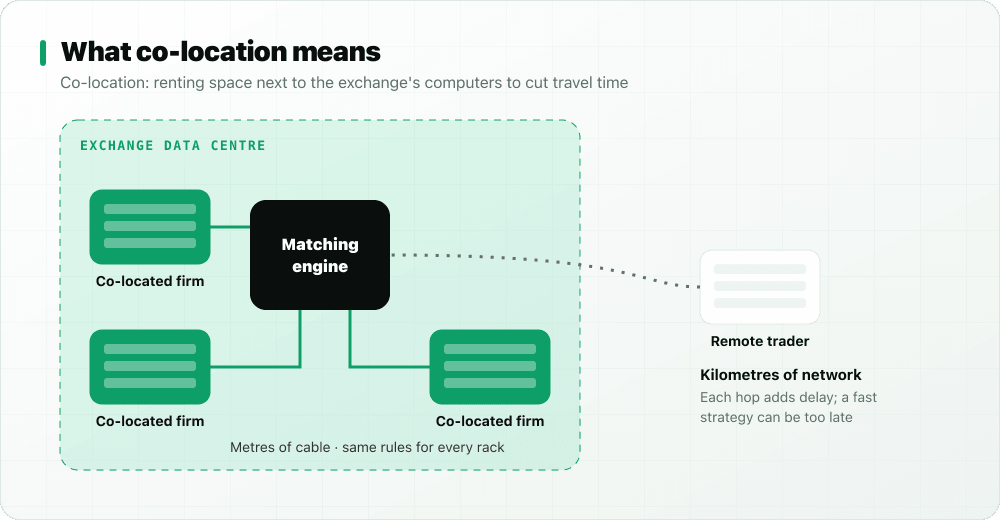
An exchange matches orders in the order they arrive. If two firms both want to buy at the same price, the one that arrives first is filled first. When prices change thousands of times a second, being a few microseconds earlier can decide whether a firm gets the trade, or gets left holding a stale quote.
So HFT firms invest in anything that shortens the trip between "something changed" and "my order is in":
- Co-location: renting rack space inside or next to the exchange's data centre.
- Fast market data: direct feeds from the exchange rather than slower consolidated ones.
- Hardware and networks: tuned servers, special network cards and sometimes microwave links between cities.
- Lean software: code written to make decisions in microseconds.
What HFT firms actually do
| Activity | What it means | How it earns |
|---|---|---|
| Market making | Quoting a price to buy (bid) and a price to sell (ask) all day | The small gap between bid and ask, many times. More here |
| Arbitrage | Buying in one place and selling the same or a linked thing elsewhere | Tiny price differences that close within moments |
| Statistical arbitrage | Trading short-lived patterns between related instruments | Small, frequent edges spread over many trades |
| Event and news reaction | Reacting to data releases or order-book changes very quickly | Being first to adjust prices |
The debate: good or bad for markets?
Supporters say HFT market makers narrow spreads and keep prices in line across exchanges, which lowers costs for everyone. Critics say speed advantages can be unfair, that liquidity can vanish in a crisis, and that some strategies cross into manipulation. Both sides point to real events:
- The 2010 Flash Crash showed how fast automated selling and vanishing liquidity can feed each other.
- India's NSE co-location case was about whether some brokers got earlier access to exchange data.
- The Jane Street–SEBI case involves allegations about index manipulation by a large trading firm.
Regulators respond with price bands, circuit breakers, order-to-trade limits, audit trails and rules on fair access. India's SEBI also classifies retail algos as white box or black box.
What HFT means for you as a retail trader
- You will not win a speed race, and you do not need to. Your holding period is minutes to months, not microseconds.
- Spreads and fees matter more than speed. Use limit orders where sensible and avoid trading thin stocks on impulse.
- Avoid "HFT bots" sold to retail. A bot running on your phone is not high-frequency trading. Read our red flags for trading bot scams.
- Your edge is process: tested rules, sensible position size and a journal.
Learn the logic in practice
You can learn how automated strategies think without any special hardware. In StockYatra's Pro Chart you can run 41 rule-based strategies, write your own rules or Pine Script, and see every buy and sell drawn on the chart with an honest backtest. It works on NEPSE, NSE and US practice markets with virtual coins.
Key takeaways
- HFT is very fast algorithmic trading, with positions held for seconds or less.
- Its edge comes from co-location, fast data and engineering, not secret predictions.
- Main activities: market making and arbitrage at huge scale.
- Retail traders compete on discipline and risk control, not speed.
Learn the skill, not the speed
StockYatra is a free practice app for Nepal (NEPSE), India (NSE) and US stocks. Write rules, test 41 transparent strategies or your own Pine Script in Pro Chart, backtest them on the chart, and practise with virtual coins. Nothing is real money.
More on algos, HFT and quant
- HFT vs algo vs manual trading
- Market making and the bid-ask spread
- What caused the 2010 Flash Crash?
- The NSE co-location case, explained
- Jane Street vs SEBI: the case explained
- Quant trading explained for beginners
- How trading bots and automation work
- Python for trading: your first backtest
- Algo trading: the one-page guide
- HFT: the one-page guide
- Black box AI trading, explained
StockYatra is an education app, not a broker, adviser or research analyst. Nothing here is a recommendation to buy or sell any security or to use any trading product. Case summaries are based on public orders and press reports; allegations are not findings, and outcomes can change on appeal. Practice prices are simulated and coins are virtual.