In short
- SEBI's circular of 4 February 2025 created a framework for retail investors using algorithms through broker APIs.
- White box algos disclose their logic and can be replicated; black box algos do not.
- Black-box algo providers must register as a SEBI Research Analyst and keep a research report for each algo.
- Every algo order carries an exchange-issued identifier; API access needs a static IP and two-factor authentication.
- After extensions, the framework became mandatory for all brokers from 1 April 2026.
Until recently, a retail trader in India could connect almost any third-party "algo" to a broker's API, often with little idea of who wrote it or what it did. SEBI's framework for safer participation of retail investors in algorithmic trading changed that. Its most talked-about idea is a simple label: is the algorithm a white box or a black box?
The two definitions
The circular (SEBI/HO/MIRSD/MIRSD-PoD/P/CIR/2025/0000013, dated 4 February 2025) describes:
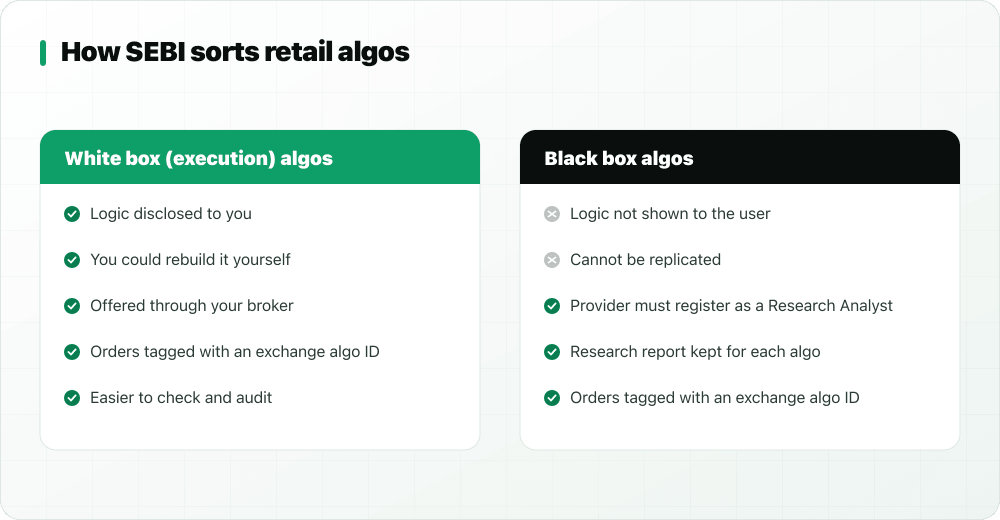
- White box, or execution, algos: algos "where logic is disclosed and replicable".
- Black box algos: algos "where the logic is not known to the user and is not replicable".
What changes because of the label
| White box algo | Black box algo | |
|---|---|---|
| Logic | Disclosed to the user and replicable | Not known to the user, not replicable |
| Provider | Empanelled with exchanges, onboarded by the broker | Must also register with SEBI as a Research Analyst |
| Paperwork | Algo registered with the exchange through the broker | A detailed research report maintained for each algo |
| Orders | Tagged with an exchange-issued algo identifier | Tagged with an exchange-issued algo identifier |
| Changes | A changed algo needs fresh approval | A changed algo needs fresh approval |
The logic is simple: if you cannot see what an algorithm does, someone accountable should. A registered Research Analyst can be inspected and held to SEBI's rules for research.
The plumbing every algo trader now lives with
- Brokers are the principal. Algo providers act as the broker's agents, and the broker is responsible for what runs through its systems.
- No open APIs. API access uses a vendor-specific key and a static IP address whitelisted by your broker.
- Two-factor authentication is required to access the API, and OAuth-based login replaces older methods.
- Algo ID on every order. Each algorithmic order is tagged with an identifier from the exchange, which leaves an audit trail.
- Kill switch. Exchanges can halt orders coming from a particular algo ID.
- Your own algo. If you write your own and stay below an order-per-second threshold set by the industry standards forum, you do not need to register it, but you cannot hand it out beyond close family. Cross the threshold and it must be registered through your broker.
Key dates
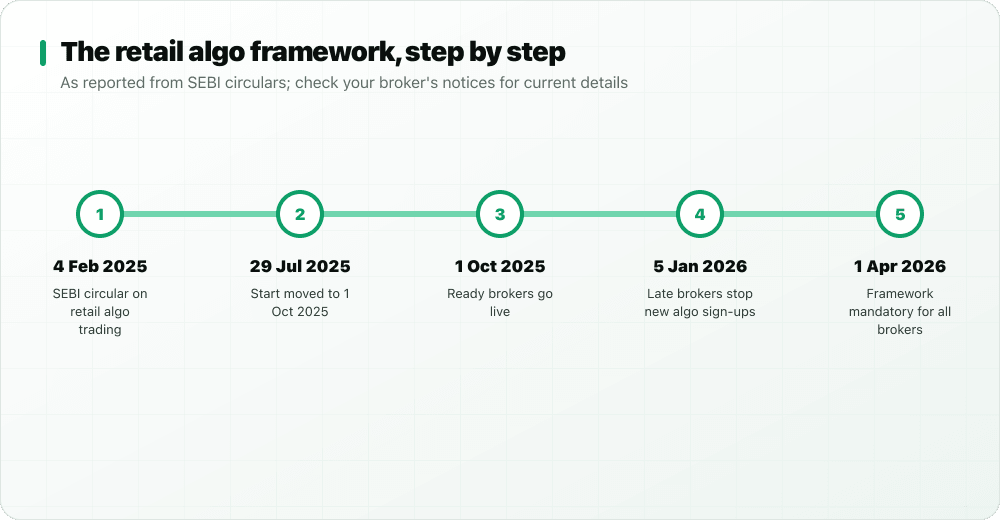
The provisions were first due from 1 August 2025. SEBI moved that to 1 October 2025, and then set a glide path: brokers that were ready could go live from 1 October 2025, the rest had milestones through late 2025 and a mock session by early January 2026, brokers that missed them could not onboard new retail algo clients from 5 January 2026, and the framework became mandatory for all brokers from 1 April 2026.
Questions to ask before you use any algo
- Is it a white box or a black box under SEBI's framework?
- If black box: what is the provider's SEBI Research Analyst registration number? Check it on SEBI's website.
- Is the provider empanelled with the exchange, and does my broker list this algo?
- What are the live results since launch, with maximum drawdown and costs included?
- What happens if it misbehaves: who can stop it, and how fast?
- What am I paying, and can I stop at any time?
Learning before automating
Automating a strategy you do not understand only makes mistakes faster. A better order is: learn the rule, test it on charts, practise it by hand, and only then think about automation. StockYatra's Pro Chart is a practice version of the white-box idea: every one of its 41 strategies shows its rules and draws each signal on NSE, NEPSE and US charts, and you can write your own in Pine Script or with the no-code builder. Nothing there connects to a broker or trades real money.
Key takeaways
- White box = disclosed, replicable logic; black box = hidden logic.
- Black-box providers must register as SEBI Research Analysts and keep a research report per algo.
- Every algo order carries an exchange ID; APIs need static IPs and 2FA.
- Mandatory for all brokers from 1 April 2026.
- Registration shows who is accountable; it does not promise profits.
Understand a strategy before you automate it
StockYatra is a free practice app for Nepal (NEPSE), India (NSE) and US stocks. Test 41 transparent strategies, write your own rules or Pine Script, and backtest them on the chart with virtual coins. Nothing is hidden and nothing is real money.
The black box AI series
- What is black box AI in trading?
- AI trading bot scams: 10 red flags
- Black box or white box: where beginners should start
- Can AI predict the stock market?
- Unusual volume, options flow and dark pools, explained
- Black box AI trading: the one-page guide
- Pro Chart: 41 strategies with every rule shown
StockYatra is an education app, not a broker, adviser or research analyst. Nothing here is a recommendation to buy or sell any security or to use any trading product. Rules and dates are summarised for learning; check the regulator's and your broker's current notices before acting. Practice prices are simulated and coins are virtual.