In short
- NSE sold co-location so brokers' servers could sit next to its systems and receive a fast tick-by-tick (TBT) data feed.
- Complaints in 2015 alleged that some brokers, notably OPG Securities, got earlier access to that feed than others.
- SEBI passed orders in 2019. In January 2023 the Securities Appellate Tribunal (SAT) set aside most of the order against NSE and replaced it with a penalty.
- In 2024 SEBI found no sufficient evidence of collusion, but other findings against OPG remained. The case shaped fair-access rules in India.
Speed only matters if everyone plays by the same rules. India's NSE co-location case was about exactly that: whether some brokers connected to the exchange's fast data feed in a way that let them see information before others. It is one of the most cited examples of how high-frequency trading raises questions of fairness.
This summary is based on SEBI and tribunal orders as reported in the press. It is simplified for learning; read the orders themselves for the legal detail.
Background: co-location and the TBT feed
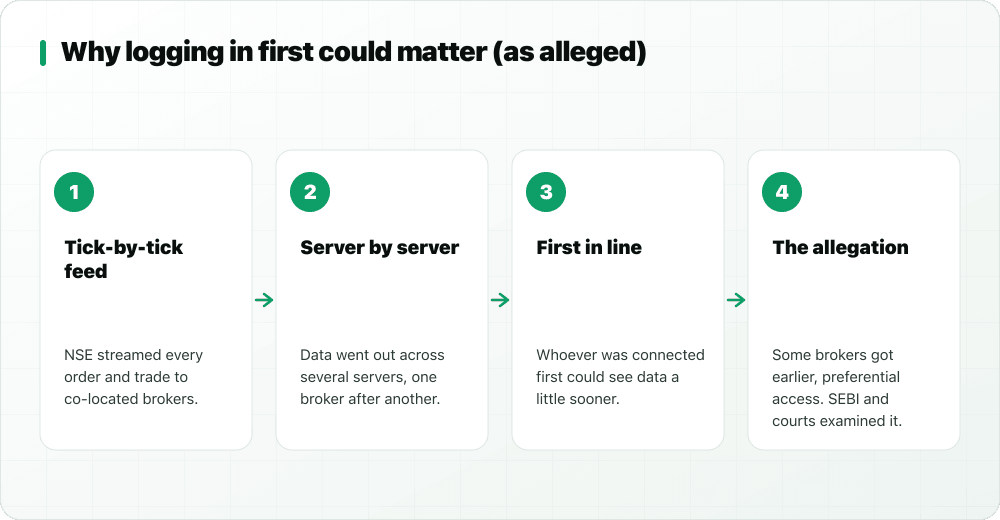
Like many exchanges, NSE offers co-location: members can place their servers in its data centre. Co-located brokers could subscribe to a tick-by-tick feed that streamed every order and trade. According to reports on the case, the feed was sent out through several servers, and data reached connected brokers one after another, so being among the first to connect could mean receiving data slightly sooner.
The allegations
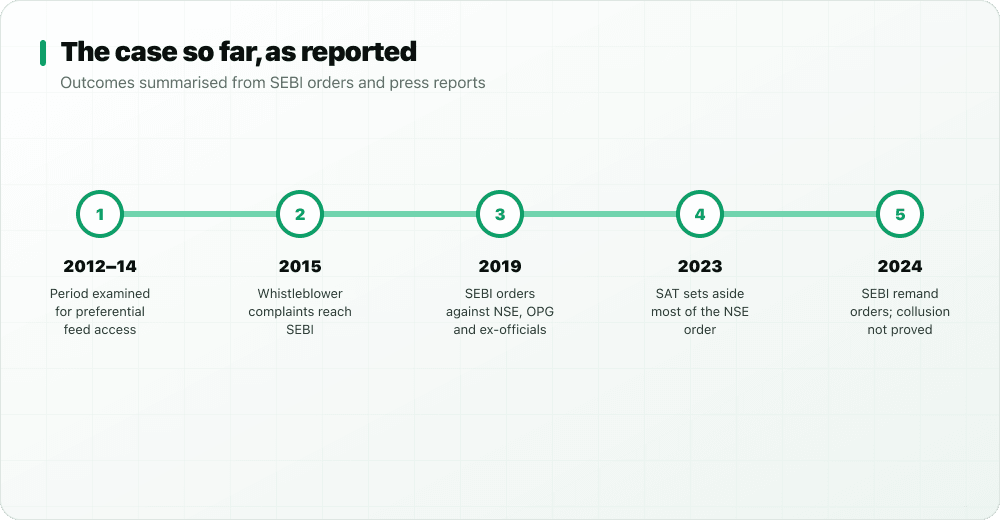
In 2015 SEBI received whistleblower complaints alleging that some brokers, with OPG Securities named most prominently, were getting preferential access, including by connecting to less-loaded or backup servers and logging in first. Reports also describe an audit commissioned by NSE that looked at connection patterns over 2012–14. NSE's systems, governance and monitoring came under scrutiny, along with the conduct of former senior officials.
What the regulators and courts decided (as reported)
- 2019: SEBI ordered NSE to disgorge about ₹625 crore with interest and barred it from accessing the securities market for six months (for example, from launching new products), and passed orders against OPG Securities and former officials.
- January 2023: SAT set aside the disgorgement and the six-month restriction on NSE and replaced them with a ₹100 crore penalty for lapses in diligence. It upheld the finding of unfair trade practice against OPG but asked SEBI to re-examine the amount and look again at possible collusion.
- 2024: On re-examination, SEBI found insufficient evidence of collusion between OPG and NSE officials, while noting NSE lacked a defined policy for use of the facility. A separate order recalculated the amount OPG had to disgorge.
Related criminal investigations were also reported. Several matters have been appealed, so treat any single figure as a snapshot and check the latest orders.
What changed, and what it means for you
- Exchanges and regulators focused more on fair, verifiable access: how data is distributed, how connections are logged, and audits of the technology.
- India's later rules for retail algos, including the white box / black box framework, continue the same theme of traceability.
- For retail traders, the takeaway is not to chase speed. Your edge is risk control and good process. Learn how professionals think about speed in our HFT explainer.
Key takeaways
- The case centred on alleged earlier access to NSE's tick-by-tick feed.
- SEBI's 2019 orders were largely modified on appeal in 2023; parts were re-examined in 2024.
- Allegations and findings differ; outcomes can change on appeal.
- Fair access and audit trails are now central to market design in India.
Learn market structure by practising
StockYatra is a free practice app for Nepal (NEPSE), India (NSE) and US stocks. Write rules, test 41 transparent strategies or your own Pine Script in Pro Chart, backtest them on the chart, and practise with virtual coins. Nothing is real money.
More on algos, HFT and quant
- What is high-frequency trading?
- HFT vs algo vs manual trading
- Market making and the bid-ask spread
- What caused the 2010 Flash Crash?
- Jane Street vs SEBI: the case explained
- Quant trading explained for beginners
- How trading bots and automation work
- Python for trading: your first backtest
- Algo trading: the one-page guide
- HFT: the one-page guide
- Black box AI trading, explained
StockYatra is an education app, not a broker, adviser or research analyst. Nothing here is a recommendation to buy or sell any security or to use any trading product. Case summaries are based on public orders and press reports; allegations are not findings, and outcomes can change on appeal. Practice prices are simulated and coins are virtual.