In short
- On May 6, 2010, US stock indexes fell sharply within minutes and recovered most of the drop soon after.
- The SEC–CFTC staff report pointed to a large automated sell program in E-mini futures, executed without regard to price or time.
- High-frequency traders first absorbed the selling, then sold too; liquidity vanished and some stocks traded at absurd prices.
- Afterwards, regulators added single-stock price bands, reworked circuit breakers and banned stub quotes.
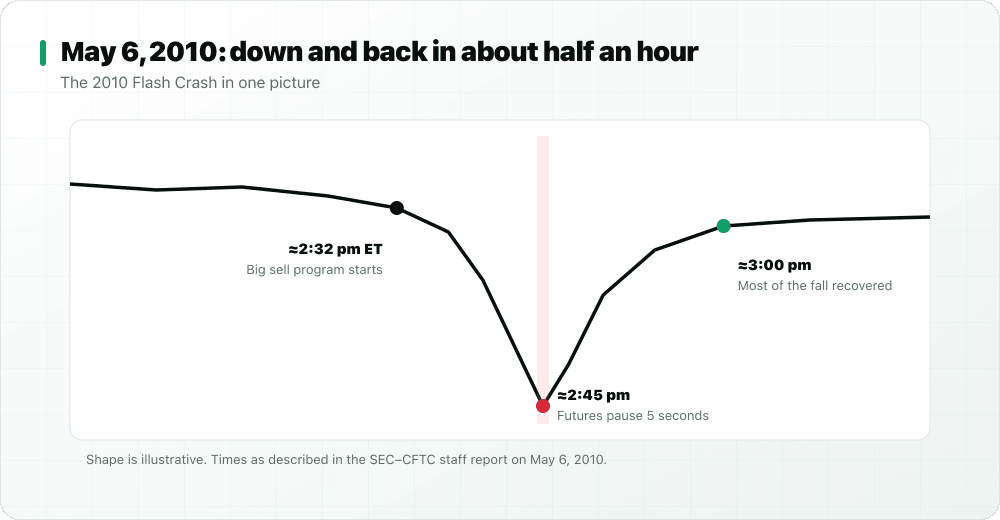
The Flash Crash is the classic story told whenever people ask whether algorithms make markets fragile. In the space of minutes, the Dow Jones Industrial Average fell close to 1,000 points and some well-known shares briefly traded for a penny or for thousands of dollars, before prices largely snapped back.
What the regulators found
The joint staff report of the SEC and CFTC, released in October 2010, described the sequence like this:
- Markets were already nervous that afternoon.
- A large fund complex began selling 75,000 E-mini S&P 500 futures contracts (about $4.1 billion) using an algorithm set to trade a fixed percentage of recent volume, without regard to price or time.
- High-frequency traders and other intermediaries bought at first, then quickly sold to reduce their positions. The rising volume made the sell algorithm sell even faster.
- Buyers stepped back. In individual stocks, liquidity dried up and orders hit "stub quotes", placeholder bids far below the real price.
- A brief automatic pause in the futures market (about five seconds) helped buyers return, and prices recovered.
The spoofing twist
In 2015, US authorities charged a UK trader, Navinder Sarao, with spoofing in E-mini futures, including on May 6, 2010. He later pleaded guilty. How much his activity contributed to the crash is still debated; many analysts see it as one factor among several, not the cause.
What changed afterwards
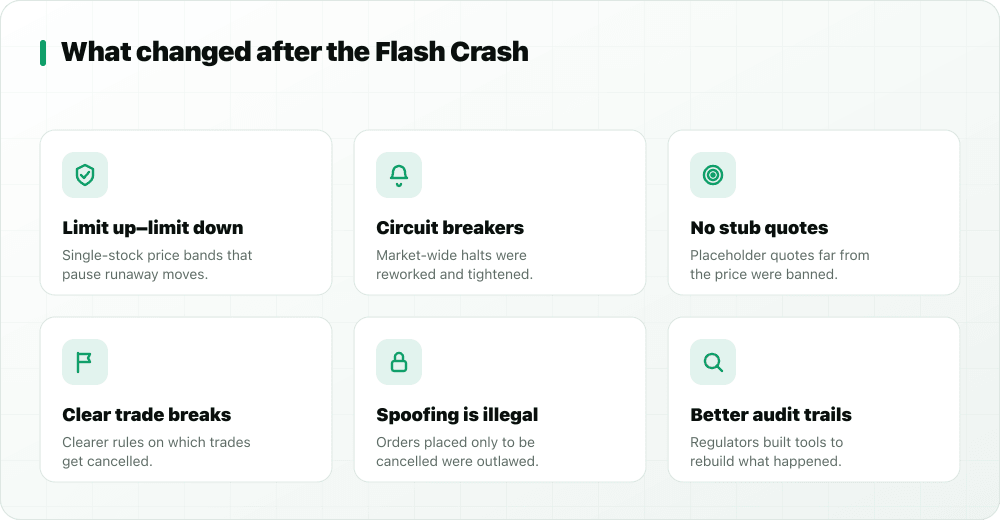
- Single-stock circuit breakers, later replaced by the limit up–limit down plan, which keeps trades within price bands and pauses runaway moves.
- Market-wide circuit breakers were reworked.
- Stub quotes were banned.
- Clearer rules on cancelling clearly erroneous trades.
- Spoofing was explicitly outlawed in US futures law, and regulators built better audit trails.
India and other markets use similar tools: price bands, circuit filters and index-wide halts.
Lessons for traders
- Market orders in a panic are dangerous. In thin markets they can fill far from the last price. Prefer limit orders.
- Automated rules need limits. The sell algorithm did exactly what it was told. Every bot needs price checks and a kill switch, see trading bots and automation.
- Liquidity is not guaranteed. It can vanish exactly when you need it.
You can practise order types safely: StockYatra supports Market, Limit and Stop orders on practice NEPSE, NSE and US stocks, so you can see how each one behaves without risking money.
Key takeaways
- The Flash Crash was a feedback loop between a large automated sell program and vanishing liquidity.
- HFT firms first absorbed and then added to the selling.
- Price bands, reworked circuit breakers and a stub-quote ban followed.
- Use limit orders and hard limits on any automation.
Practise order types safely
StockYatra is a free practice app for Nepal (NEPSE), India (NSE) and US stocks. Write rules, test 41 transparent strategies or your own Pine Script in Pro Chart, backtest them on the chart, and practise with virtual coins. Nothing is real money.
More on algos, HFT and quant
- What is high-frequency trading?
- HFT vs algo vs manual trading
- Market making and the bid-ask spread
- The NSE co-location case, explained
- Jane Street vs SEBI: the case explained
- Quant trading explained for beginners
- How trading bots and automation work
- Python for trading: your first backtest
- Algo trading: the one-page guide
- HFT: the one-page guide
- Black box AI trading, explained
StockYatra is an education app, not a broker, adviser or research analyst. Nothing here is a recommendation to buy or sell any security or to use any trading product. Case summaries are based on public orders and press reports; allegations are not findings, and outcomes can change on appeal. Practice prices are simulated and coins are virtual.