In short
- The bid is the best price someone will pay; the ask is the best price someone will sell at.
- The spread is the gap between them, and you pay it when you buy and sell with market orders.
- A market maker quotes both sides and earns the spread, taking on inventory risk.
- Liquid stocks have tight spreads; thin stocks have wide ones. Check before you trade.
When an app shows a stock price, it is really showing a summary of two prices: what buyers are offering and what sellers are asking. Understanding that gap, and the people who fill it, is one of the most useful things a new trader can learn.
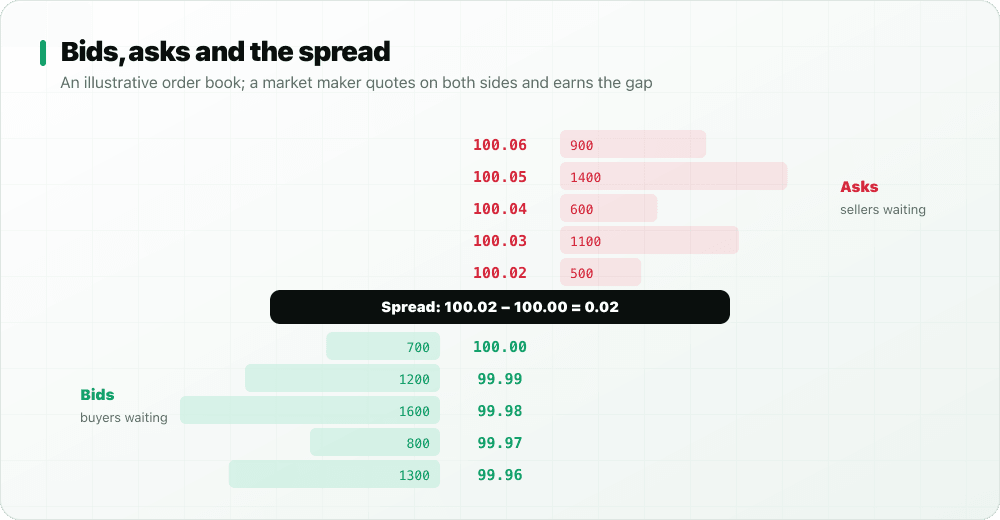
The order book in two minutes
The order book lists waiting limit orders. Sell orders (asks) sit above the price, buy orders (bids) below. The best ask and the best bid define the spread. A market buy order takes the cheapest ask; a market sell order hits the highest bid.
In the example, buying with a market order costs 100.02, but selling straight back gets only 100.00. That 0.02 is a cost even if the price never moves.
What a market maker does
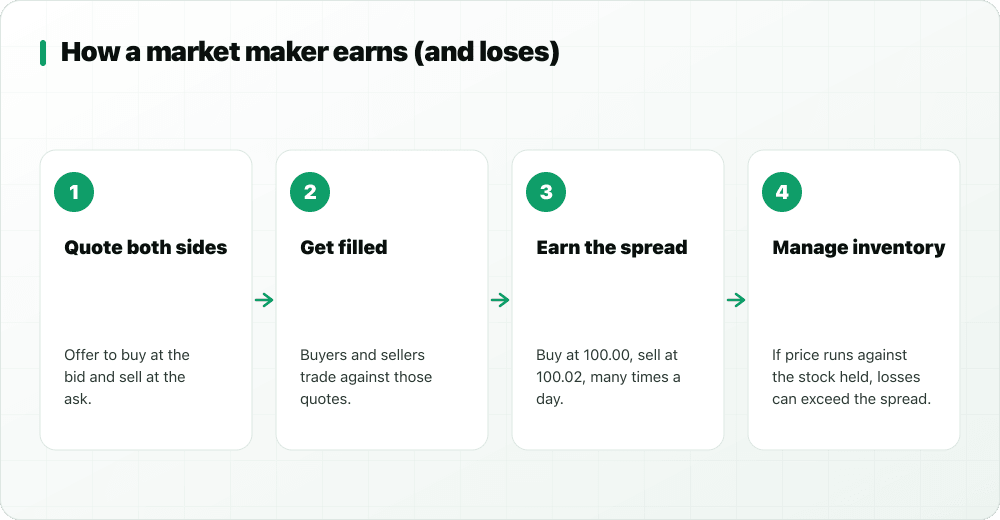
Market makers continuously quote a bid and an ask. When others trade against those quotes, the market maker buys low and sells a little higher, again and again. Many large market makers are automated and fast, which is why market making is the biggest high-frequency trading activity.
The risk is inventory: if a market maker has bought shares and the price falls, the loss can wipe out many spreads. That is why spreads widen when markets are volatile or news is coming, and why liquidity can disappear in a panic, as in the 2010 Flash Crash.
| Situation | Spread | Why |
|---|---|---|
| Large, heavily traded stock | Tight | Many buyers and sellers, competing quotes |
| Small, thinly traded stock | Wide | Few orders; quoting is riskier |
| Before big news | Widens | Market makers protect against sudden moves |
| Market open and close | Often wider | Prices are still being discovered |
How to use this as a trader
- Look at the spread before trading; skip trades where it eats your expected move.
- Use limit orders in thin stocks so you choose your price.
- Be careful at the open and around news.
- Size for liquidity: in thin stocks, a big order can move the price against you.
StockYatra lets you practise Market, Limit and Stop orders on NEPSE, NSE and US practice stocks, so you can feel the difference between taking a price and setting one. (Practice prices are simulated; real spreads vary by market and broker.)
Key takeaways
- The bid-ask spread is the gap between the best buyer and the best seller.
- Market makers earn the spread and carry inventory risk.
- Spreads widen in thin stocks, at the open and around news.
- Limit orders and liquidity checks keep the spread from eating your trades.
Practise order types on three markets
StockYatra is a free practice app for Nepal (NEPSE), India (NSE) and US stocks. Write rules, test 41 transparent strategies or your own Pine Script in Pro Chart, backtest them on the chart, and practise with virtual coins. Nothing is real money.
More on algos, HFT and quant
- What is high-frequency trading?
- HFT vs algo vs manual trading
- What caused the 2010 Flash Crash?
- The NSE co-location case, explained
- Jane Street vs SEBI: the case explained
- Quant trading explained for beginners
- How trading bots and automation work
- Python for trading: your first backtest
- Algo trading: the one-page guide
- HFT: the one-page guide
- Black box AI trading, explained
StockYatra is an education app, not a broker, adviser or research analyst. Nothing here is a recommendation to buy or sell any security or to use any trading product. Case summaries are based on public orders and press reports; allegations are not findings, and outcomes can change on appeal. Practice prices are simulated and coins are virtual.