In short
- In July 2025, SEBI issued an interim order against Jane Street group entities alleging they manipulated the Bank Nifty index on certain days.
- SEBI alleged unlawful gains of about ₹4,843 crore. The firm was temporarily barred, deposited the amount in escrow, and resumed trading.
- Jane Street disputes the allegations. As of mid-October 2026 the matter is still being argued; no final order has been reported.
- An interim order is not a final finding. The case is a lesson in how index levels, derivatives and large trades interact.
Few market stories in India drew as much attention in 2025 as SEBI's action against Jane Street, one of the world's largest trading firms. This explainer summarises what has been publicly reported, in neutral terms. It is not legal analysis and does not take a side.
What SEBI alleged (interim order, July 2025)
According to SEBI's interim order as reported, the regulator alleged that Jane Street entities used a two-part pattern on certain expiry days: large purchases in Bank Nifty constituent stocks and futures early in the day, which could push the index up, while holding bigger positions in index options that would benefit if the index later fell, followed by selling later in the day. SEBI alleged this amounted to manipulation and computed alleged unlawful gains of about ₹4,843 crore.
The order was ex parte and interim: issued before the firm had responded, with a final decision to follow after hearing its defence.
What happened next (as reported)
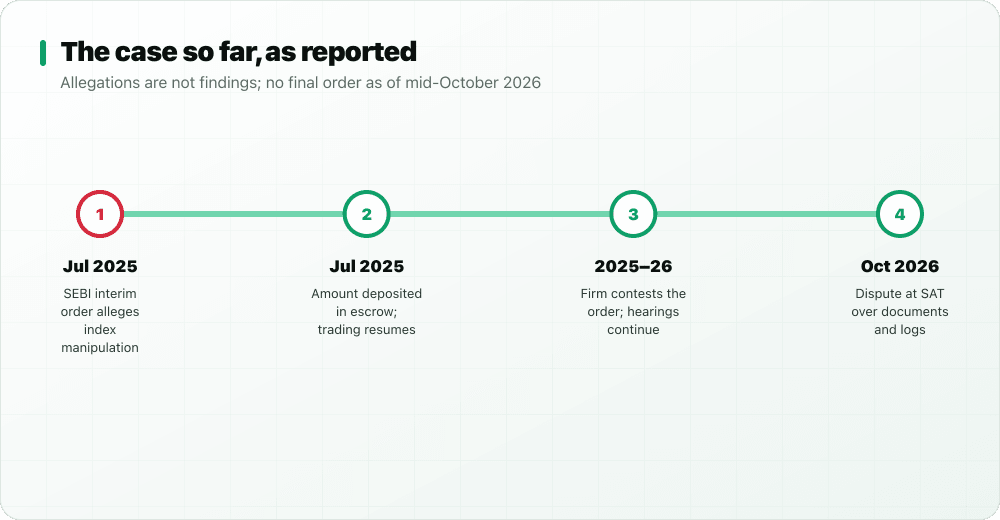
- July 2025: the entities were temporarily barred from Indian markets. After the alleged amount was deposited in an escrow account, the restriction was lifted and trading resumed later that month.
- 2025–26: Jane Street contested SEBI's findings and approach.
- October 2026: reports describe a dispute before the Securities Appellate Tribunal over documents, including detailed order logs the firm sought for its defence and SEBI's position on what it had relied on.
Positions on both sides are contested and the outcome is not known. Check the latest SEBI and SAT orders before relying on any detail.
What retail traders can learn
- Indices can be moved by large trades in their biggest stocks, especially near expiry. Big moves near expiry are not always "information".
- Derivatives volume dwarfs the cash market in India, which is why regulators watch expiry days closely.
- Professional firms play a different game, with scale, data and risk systems retail traders do not have. Competing with them on short-term index moves is hard.
- Rules are tightening. SEBI has been changing derivatives rules and expiry arrangements; follow official circulars rather than social media summaries.
StockYatra does not offer options or derivatives trading. You can practise reading stock and index charts, volume and price behaviour on NSE, NEPSE and US practice markets, and test rule-based strategies in Pro Chart.
Key takeaways
- SEBI's July 2025 interim order alleged Bank Nifty manipulation by Jane Street entities.
- The amount was deposited in escrow and trading resumed; the firm contests the case.
- No final order has been reported as of mid-October 2026.
- The case shows how large trades, indices and derivatives interact around expiry.
Learn how markets move, risk-free
StockYatra is a free practice app for Nepal (NEPSE), India (NSE) and US stocks. Write rules, test 41 transparent strategies or your own Pine Script in Pro Chart, backtest them on the chart, and practise with virtual coins. Nothing is real money.
More on algos, HFT and quant
- What is high-frequency trading?
- HFT vs algo vs manual trading
- Market making and the bid-ask spread
- What caused the 2010 Flash Crash?
- The NSE co-location case, explained
- Quant trading explained for beginners
- How trading bots and automation work
- Python for trading: your first backtest
- Algo trading: the one-page guide
- HFT: the one-page guide
- Black box AI trading, explained
StockYatra is an education app, not a broker, adviser or research analyst. Nothing here is a recommendation to buy or sell any security or to use any trading product. Case summaries are based on public orders and press reports; allegations are not findings, and outcomes can change on appeal. Practice prices are simulated and coins are virtual.