In short
- Most "AI bot" scams need no AI at all, only a convincing screen.
- The pattern: social media hook → private group → fake profit → bigger deposit → withdrawal blocked.
- Regulators in the US, India and elsewhere warn about exactly this.
- The biggest red flag is any guaranteed or fixed return.
"Our AI made 4% today." "Only five slots left on the bot." "Withdraw any time." If you trade, or even just watch finance reels, you have probably seen messages like these. The words AI and black box make them sound advanced, but most of these schemes are old frauds in new clothes.
How these schemes usually run
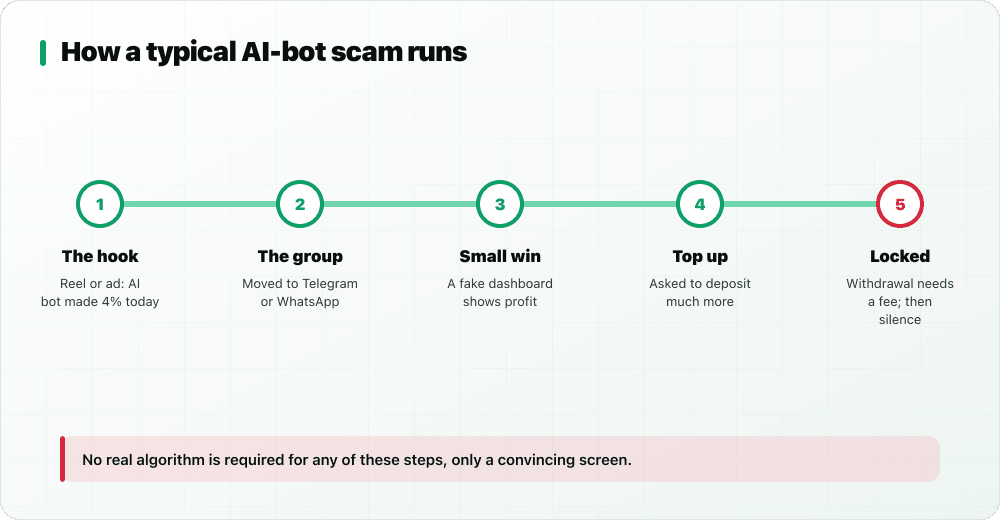
- The hook. A reel, ad or "success story" shows huge returns from an AI bot, sometimes with a fake celebrity endorsement.
- The group. You are moved to Telegram or WhatsApp, where "members" post their profits all day. Many are run by the scammers.
- The small win. You deposit a little. A dashboard shows it growing. Sometimes a small withdrawal is even allowed, to build trust.
- The top-up. You are pushed to deposit much more, or bring friends, before an "upgrade" or "limited window".
- The lock. When you try to withdraw, there is a "tax", "verification fee" or "unlock charge". Paying it leads to another fee, then silence.
The 10 red flags
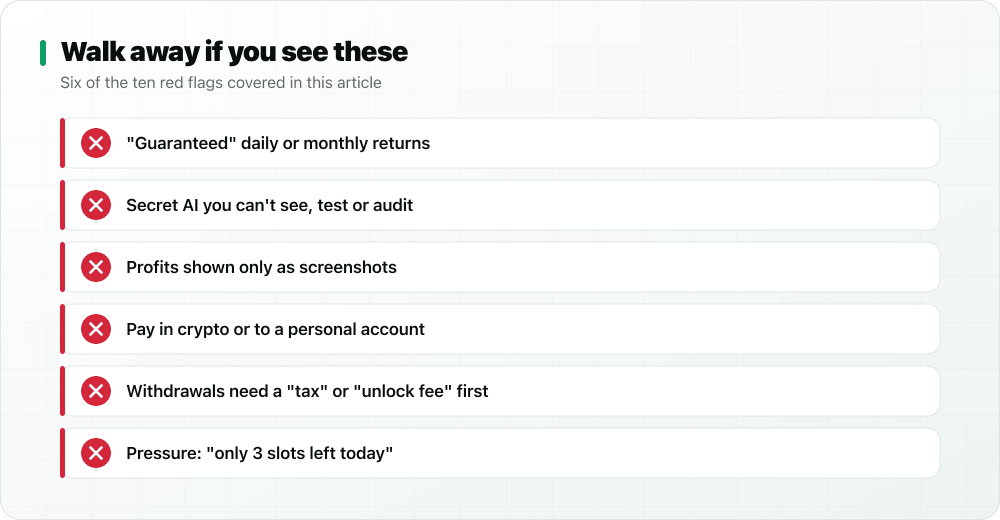
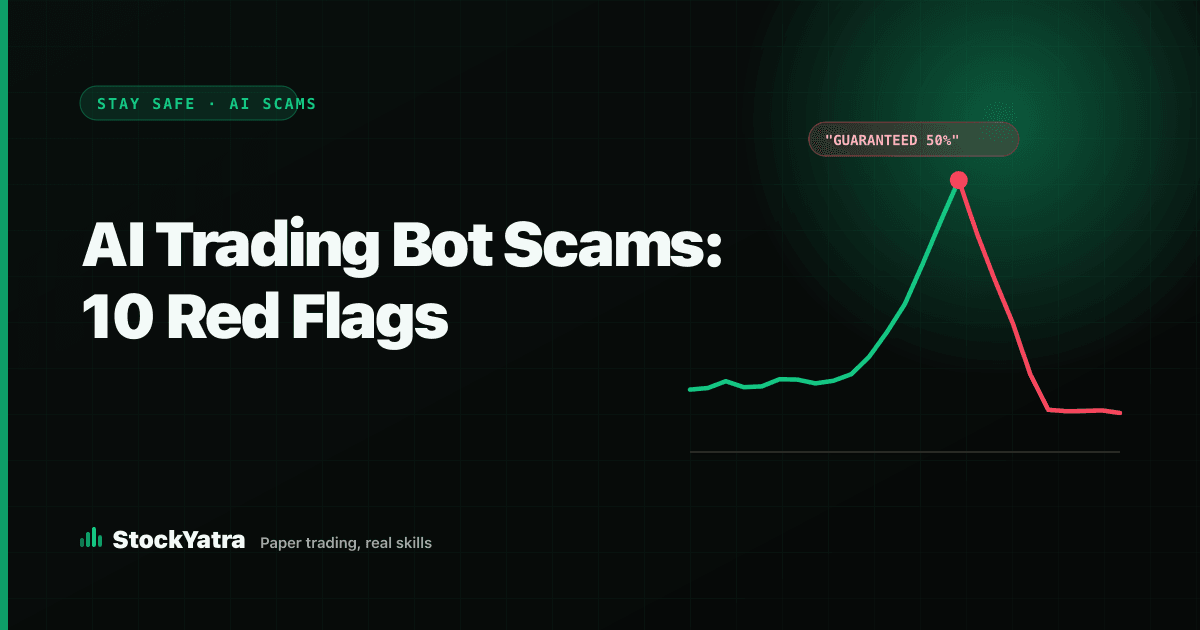
- Guaranteed or fixed returns ("2% a day", "30% a month"). Real trading has losing periods.
- A secret AI you are not allowed to see, test or audit.
- Proof only as screenshots, never as broker statements or audited reports.
- Payment to crypto wallets or personal accounts instead of a regulated broker in your own name.
- Fees to withdraw your own money.
- Pressure and scarcity: limited slots, countdowns, "today only".
- No registration you can check with SEBI, the SEC/FINRA, SEBON or your local regulator.
- Recruitment rewards: bonuses for bringing in friends.
- Remote-access requests: asking you to install screen-sharing apps or share OTPs.
- Moving off platform: from a public page to a private chat as fast as possible.
What regulators are saying
- United States. The CFTC has published an investor advisory titled "AI Won't Turn Trading Bots into Money Machines". NASAA lists AI-themed investment schemes among the top threats to investors. In December 2025 the SEC announced charges against purported crypto trading platforms and "AI investment clubs" that allegedly recruited investors through social media and WhatsApp.
- India. SEBI has repeatedly cautioned investors against unregistered entities promising assured returns through apps and social media, and its algo framework requires any black-box algo offered to retail investors to come through a broker from a provider registered as a Research Analyst.
- Nepal. Only brokers licensed by SEBON can handle share trades. Anyone offering to "trade for you" through a private account or app is outside that system.
If you have already paid
- Stop sending money, including any "fee" to unlock a withdrawal.
- Save everything: chats, wallet addresses, transaction IDs, website links.
- Report it: in India to the cybercrime portal (cybercrime.gov.in, helpline 1930) and to SEBI SCORES if a registered entity is involved; in the US to the FBI's IC3 and the SEC or CFTC; in Nepal to the Cyber Bureau of Nepal Police.
- Tell your bank or exchange quickly; transfers can sometimes be frozen.
- Beware of "recovery agents" who contact you offering to get your money back for a fee. That is often the same scam, round two.
The safer way to try trading
If you are curious about trading or algorithms, practise first with no money at stake. In StockYatra you trade NEPSE, NSE and US stocks with 10,000 free virtual coins, and every strategy in Pro Chart shows its rules and its losing trades. If a "bot" cannot beat simple, transparent rules there, it certainly should not get your savings.
Key takeaways
- Most "AI bot" schemes are ordinary fraud with an AI label.
- Guaranteed returns and withdrawal fees are the two clearest warnings.
- Verify registration with your regulator before sending anything.
- If caught, stop paying, save evidence, report fast, and ignore "recovery" offers.
Practise with money that cannot be stolen
StockYatra is a free practice app for Nepal (NEPSE), India (NSE) and US stocks. Test 41 transparent strategies, write your own rules or Pine Script, and backtest them on the chart with virtual coins. Nothing is hidden and nothing is real money.
The black box AI series
- What is black box AI in trading?
- SEBI rules: white box vs black box algos
- Black box or white box: where beginners should start
- Can AI predict the stock market?
- Unusual volume, options flow and dark pools, explained
- Black box AI trading: the one-page guide
- Pro Chart: 41 strategies with every rule shown
StockYatra is an education app, not a broker, adviser or research analyst. Nothing here is a recommendation to buy or sell any security or to use any trading product. Rules and dates are summarised for learning; check the regulator's and your broker's current notices before acting. Practice prices are simulated and coins are virtual.