In short
- Manual: you decide and click every order.
- Algo: written rules decide, and software places orders.
- HFT: algos built for extreme speed and very short holding times.
- Beginners should learn manual first, then turn tested rules into algos. HFT is a professional field.
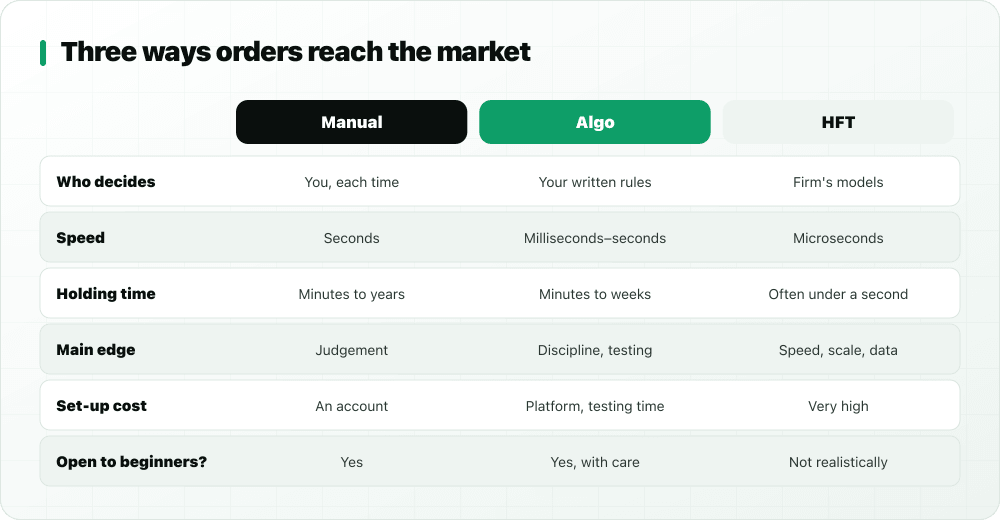
People often use "algo trading" and "HFT" as if they were the same thing, and treat both as the opposite of "normal" trading. In reality they sit on one line: how much of the decision and the clicking is done by a machine, and how fast.
Manual trading
You read the chart or the news, decide, and place the order yourself. Its strength is judgement and flexibility. Its weaknesses are emotion, inconsistency and limited time: you can only watch so many stocks.
Algorithmic trading
You write rules ("buy when the 20-period average crosses above the 50, exit when it crosses back, risk 1% per trade") and software follows them. Strengths: consistency, speed versus a human, the ability to test on past data. Weaknesses: rules break when markets change, bugs cost money, and a good backtest can still fail live. See the algo trading guide.
High-frequency trading
Algos engineered for microseconds, usually market making or arbitrage, run by specialist firms with co-location and large budgets. Read the HFT explainer.
| Question | Manual | Algo | HFT |
|---|---|---|---|
| Can I start today? | Yes | Yes, start with simple rules | No |
| Main skill | Reading markets, discipline | Rule design, testing, coding or no-code tools | Engineering, maths, infrastructure |
| Biggest risk | Emotional decisions | Overfitting and bugs | Technology and liquidity shocks |
| India note | Normal broker account | SEBI's algo framework applies to API orders | Exchange membership and co-location |
A practical path for beginners
- Learn manually on a practice account so mistakes cost nothing.
- Write your rules down. If you cannot write them, you cannot automate them.
- Backtest the rules and look at every trade, not just the final number.
- Forward-test on new data before trusting it.
- Automate in small steps: alerts first, then assisted orders. See trading bots and automation.
In StockYatra you can do steps 1 to 4 for free: practise on NEPSE, NSE and US stocks, then turn your idea into a no-code rule or a Pine script in Pro Chart and backtest it.
Key takeaways
- Manual, algo and HFT differ in who decides and how fast.
- Algo trading is open to retail; HFT is a professional, infrastructure-heavy field.
- Automate only rules you have written, tested and journalled.
Learn the skill, not the speed
StockYatra is a free practice app for Nepal (NEPSE), India (NSE) and US stocks. Write rules, test 41 transparent strategies or your own Pine Script in Pro Chart, backtest them on the chart, and practise with virtual coins. Nothing is real money.
More on algos, HFT and quant
- What is high-frequency trading?
- Market making and the bid-ask spread
- What caused the 2010 Flash Crash?
- The NSE co-location case, explained
- Jane Street vs SEBI: the case explained
- Quant trading explained for beginners
- How trading bots and automation work
- Python for trading: your first backtest
- Algo trading: the one-page guide
- HFT: the one-page guide
- Black box AI trading, explained
StockYatra is an education app, not a broker, adviser or research analyst. Nothing here is a recommendation to buy or sell any security or to use any trading product. Case summaries are based on public orders and press reports; allegations are not findings, and outcomes can change on appeal. Practice prices are simulated and coins are virtual.