In short
- SEBI's circular of 4 February 2025 set a framework for safer participation of retail investors in algorithmic trading.
- Brokers are the principal; algo providers are their agents and must be empanelled with the exchanges.
- Every algo order carries an exchange-issued algo ID; API access needs a static IP, OAuth login and two-factor authentication.
- Black-box algo providers must also register as SEBI Research Analysts.
- As reported, the framework became mandatory for all brokers from 1 April 2026.
For years, a retail trader in India could plug almost any script or third-party "strategy" into a broker's API. Nobody, including the broker, always knew what was running or who wrote it. SEBI's framework changed that by putting every retail algo inside a chain of responsibility. This guide covers what changed and what it means if you write your own code or use someone else's.
How an algo order now travels
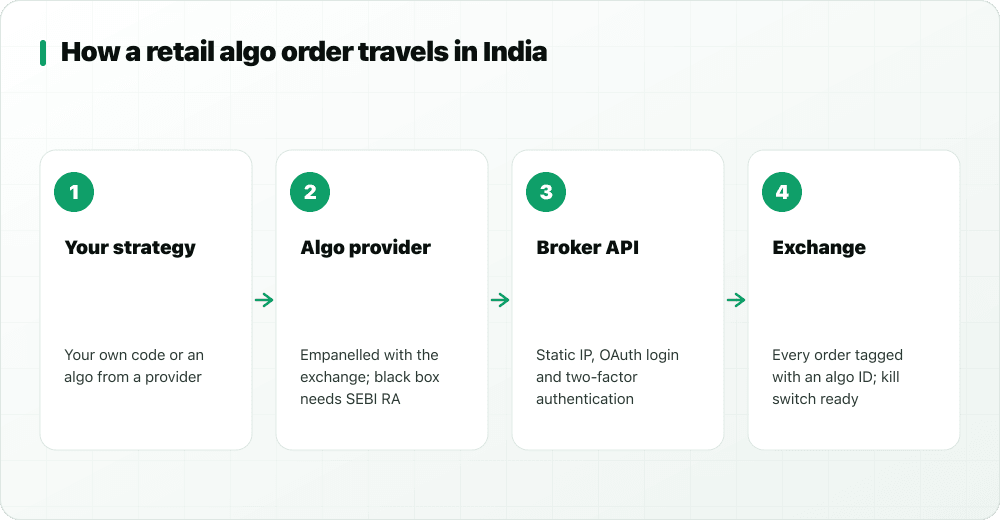
- Brokers are the principal. The broker is responsible for algos running through its systems. Algo providers act as the broker's agents.
- Providers are empanelled. Third-party algo providers must be empanelled with the stock exchanges before brokers can offer their algos.
- Exchange approval and an algo ID. Algos are approved through the broker, and every algo order is tagged with a unique identifier issued by the exchange. That gives an audit trail.
- Kill switch. Exchanges can stop orders from a particular algo ID.
The API rules every algo trader lives with
- No open APIs. Access uses a vendor-specific key and a static IP address registered with your broker.
- OAuth login and two-factor authentication for API sessions.
- Your own algo. If you write your own code and stay below the order-per-second threshold set by the exchanges and industry standards forum, it does not need separate registration, but you may share it only with close family. Above the threshold, it must be registered through your broker. Your broker publishes the current threshold.
White box vs black box
The framework sorts algos into two kinds. White box (execution) algos are those "where logic is disclosed and replicable". Black box algos are those "where the logic is not known to the user and is not replicable". Providers of black-box algos must register with SEBI as a Research Analyst and keep a detailed research report for each algo. The full explanation is in SEBI white box vs black box rules.
Key dates
The circular is dated 4 February 2025. As reported, its start was moved from 1 August 2025 to 1 October 2025 with a glide path for brokers; brokers that missed their milestones could not onboard new retail algo clients from 5 January 2026; and the framework became mandatory for all brokers from 1 April 2026. Your broker's notices have the details that apply to your account.
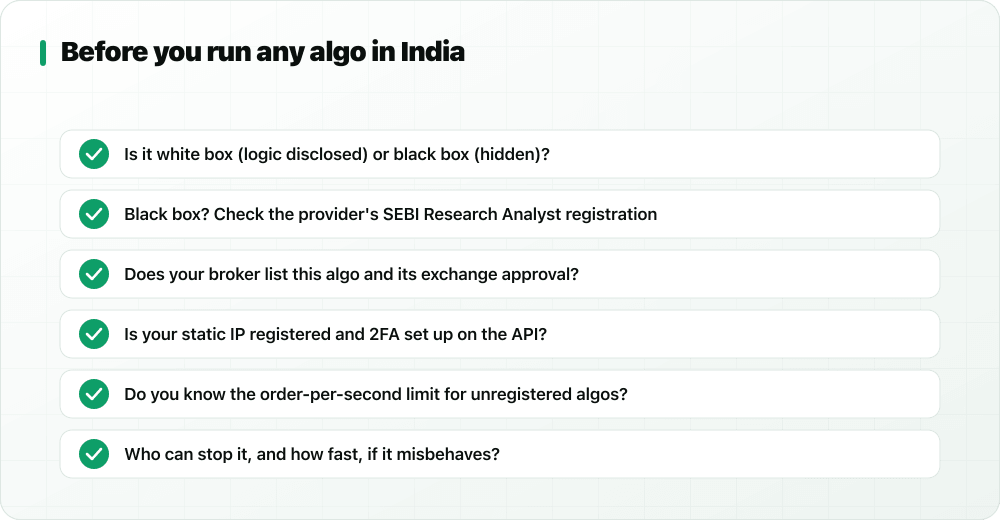
Checklist before you run any algo
What retail traders should do now
- Ask your broker which algos and platforms it has onboarded, and how its API, static IP and 2FA set-up works.
- Check registrations. For any black-box product, look up the provider's Research Analyst registration on SEBI's website.
- Avoid unofficial routes: shared API keys, "copy my bot" Telegram groups and screen-scraping tools that bypass the broker.
- Test before you automate. Backtest with costs, then paper trade. Automation only makes a strategy faster, not better.
Practise the strategy before the paperwork
StockYatra does not connect to brokers or send real orders. It is a place to learn the strategy side: test 41 transparent strategies on NSE (and NEPSE and US) practice charts in Pro Chart, write rules with the no-code builder or Pine Script, and trade them with virtual coins until you know how they behave.
Key takeaways
- Brokers are responsible; providers are empanelled agents.
- Every algo order has an exchange ID; APIs need static IP, OAuth and 2FA.
- Your own low-frequency algo needs no registration but cannot be shared beyond family.
- Black-box providers must be SEBI-registered Research Analysts.
- Mandatory for all brokers from 1 April 2026, as reported.
Learn the strategy before you automate it
StockYatra is a free practice app for Nepal (NEPSE), India (NSE) and US stocks. Test 41 transparent strategies, write rules without code or in Pine Script, and backtest them on the chart with virtual coins. Nothing connects to a broker and nothing is real money.
The algo trading series
- What is algorithmic trading?
- Is algo trading allowed in Nepal?
- How to backtest a trading strategy
- Classic algo trading strategies, explained
- Algo trading vs manual trading
- How to start algo trading as a beginner
- Algo trading: the one-page guide
- Black box AI trading, explained
- Pro Chart: 41 strategies with every rule shown
StockYatra is an education app, not a broker, adviser or research analyst. Nothing here is a recommendation to buy or sell any security, to use any trading product, or legal advice. Rules and dates are summarised for learning; check the regulator's and your broker's current notices before acting. Practice prices are simulated and coins are virtual.