In short
- A black box is a trading system whose logic you cannot see: data goes in, a buy or sell signal comes out.
- A white box shows its rules, so you can rebuild, test and question it.
- Black boxes power real things (fund models, execution engines, alert scanners) and also a lot of scams.
- Before trusting any black box, ask for audited results, risk numbers and who is regulated for it.
Search "black box AI" today and you will find two very different worlds. In India, the phrase entered everyday trading talk because SEBI now sorts retail algorithms into white box and black box. In the US, it is attached to AI signal bots and to alert platforms that scan options flow and dark pool trades. On social media it is attached to something else again: "secret AI" that promises a fixed return every day.
This guide explains what the term really means, how such a system works inside, where it is useful, where it fails, and how to judge one without being able to look inside.
Black box, in one sentence
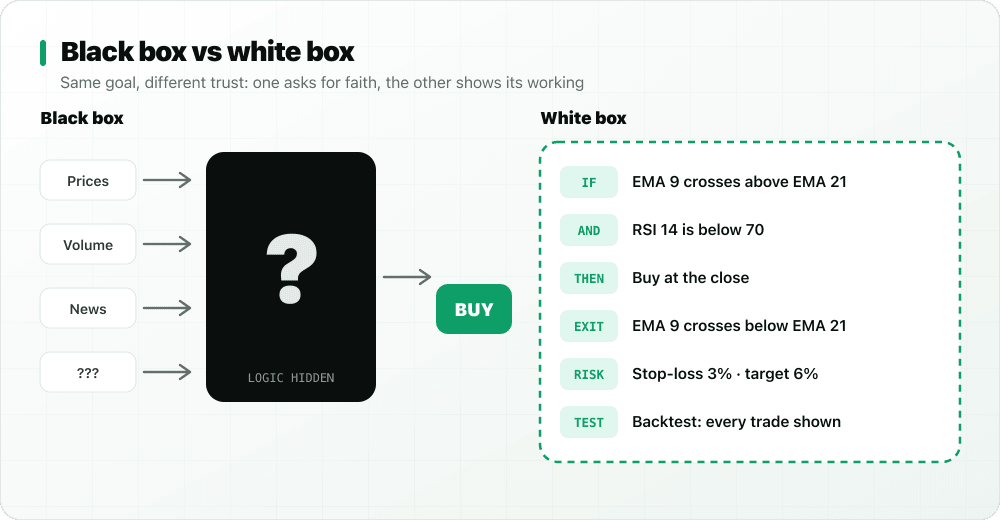
In trading, a black box is any system that turns market data into decisions without telling you how. You see the inputs (prices, perhaps news) and the outputs (buy, sell, size), but not the logic between them. The logic may be hidden because it is a trade secret, because it is a machine-learning model that even its builders cannot fully explain, or because there is no real logic at all.
A white box is the opposite: the rules are written down. "Buy when the 9-day EMA crosses above the 21-day EMA, but only if RSI is below 70" is a white box. Anyone can rebuild it, test it on old data and argue with it.
How a trading black box works
Strip away the marketing and almost every trading system, black or white, has the same five stages:
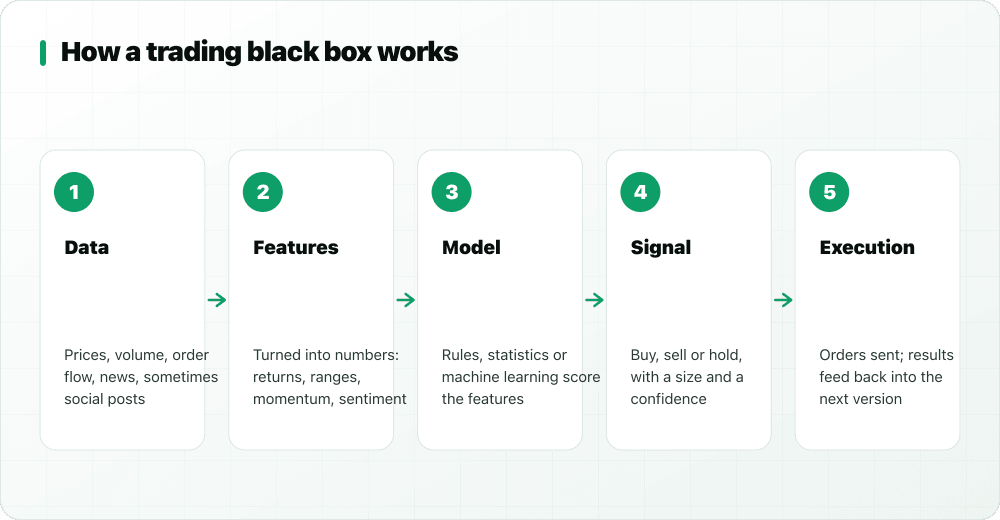
- Data. Prices and volume, sometimes the order book, company filings, news headlines or social media posts.
- Features. Raw data is turned into numbers a model can use: returns over the last few days, distance from a moving average, volatility, a sentiment score for a headline.
- Model. Something scores those features. It can be simple rules, a statistical model, or machine learning such as gradient-boosted trees or neural networks.
- Signal. The score becomes an action: buy, sell or wait, with a size and often a confidence level.
- Execution and feedback. Orders are sent, results are recorded, and the model is retrained or tuned on what happened.
What makes it a black box is not the maths. It is that steps 2 to 4 are hidden from the person relying on the signal.
Four kinds of black box you will meet
| Kind | Who uses it | What it does | What you can check |
|---|---|---|---|
| Quant fund and HFT models | Hedge funds, prop firms, market makers | Find small statistical edges across thousands of instruments, often holding for seconds to weeks | Only the fund's audited returns; the models stay private |
| Execution algorithms | Brokers and institutions | Split a big order into small pieces to reduce market impact (for example, following VWAP) | The rules are usually documented, which is why regulators often treat these as white box |
| Alert scanners and "AI scores" | Active retail traders, mostly in the US | Flag unusual volume, big options orders, dark pool prints or breakouts, sometimes with a model's ranking | What was flagged is visible; why a model ranked it highly usually is not |
| Retail signal bots | Sold to beginners through apps, Telegram and social media | Send buy/sell calls or trade an account automatically | Often nothing at all, which is the problem |
Where black boxes are genuinely useful
- Speed and scale. A scanner can check every stock on an exchange every second. No person can.
- Discipline. A model does not panic-sell or revenge-trade. It follows its rules.
- Execution. Splitting a large order intelligently saves real money for funds.
- Finding things to look at. Used as a filter ("show me what is moving unusually"), a black box narrows thousands of stocks down to a few worth studying.
Where they fail
- Overfitting. A model tuned hard on past data can learn the noise of that period instead of anything lasting. It looks brilliant in a backtest and fails live.
- Regime change. A model trained in a calm, rising market can break when volatility or interest rates change. The 2020 crash and other shocks are full of such stories.
- No explanation. When it starts losing, you cannot tell whether it is a normal bad patch or broken for good.
- Crowding. If many systems chase the same pattern, the edge disappears, and their exits can collide.
- Survivorship. You hear about the bots that worked. The hundreds that quietly lost money are never advertised.
- Costs. Fees, slippage and subscription prices can eat a small edge completely.
How to judge a black box you cannot open
- Who is accountable? In India, a black-box algo offered to retail traders must come from a provider registered with SEBI as a Research Analyst, through your broker. In the US, anyone managing your money should be a registered adviser or broker. No registration, no deal.
- Results you can verify. Ask for audited or broker-statement performance over years, not screenshots.
- The bad numbers. Maximum drawdown, worst month, number of trades, how results changed after fees. A seller who will not show these is hiding them.
- Live versus backtest. How has it done since it went live, compared with the backtest it was sold on?
- What it will not do. Any promise of a fixed or guaranteed return is a red flag. Real systems have losing periods.
- Can you leave? You should be able to stop it and withdraw at any time, without a "fee" to unlock your money.
The white-box alternative
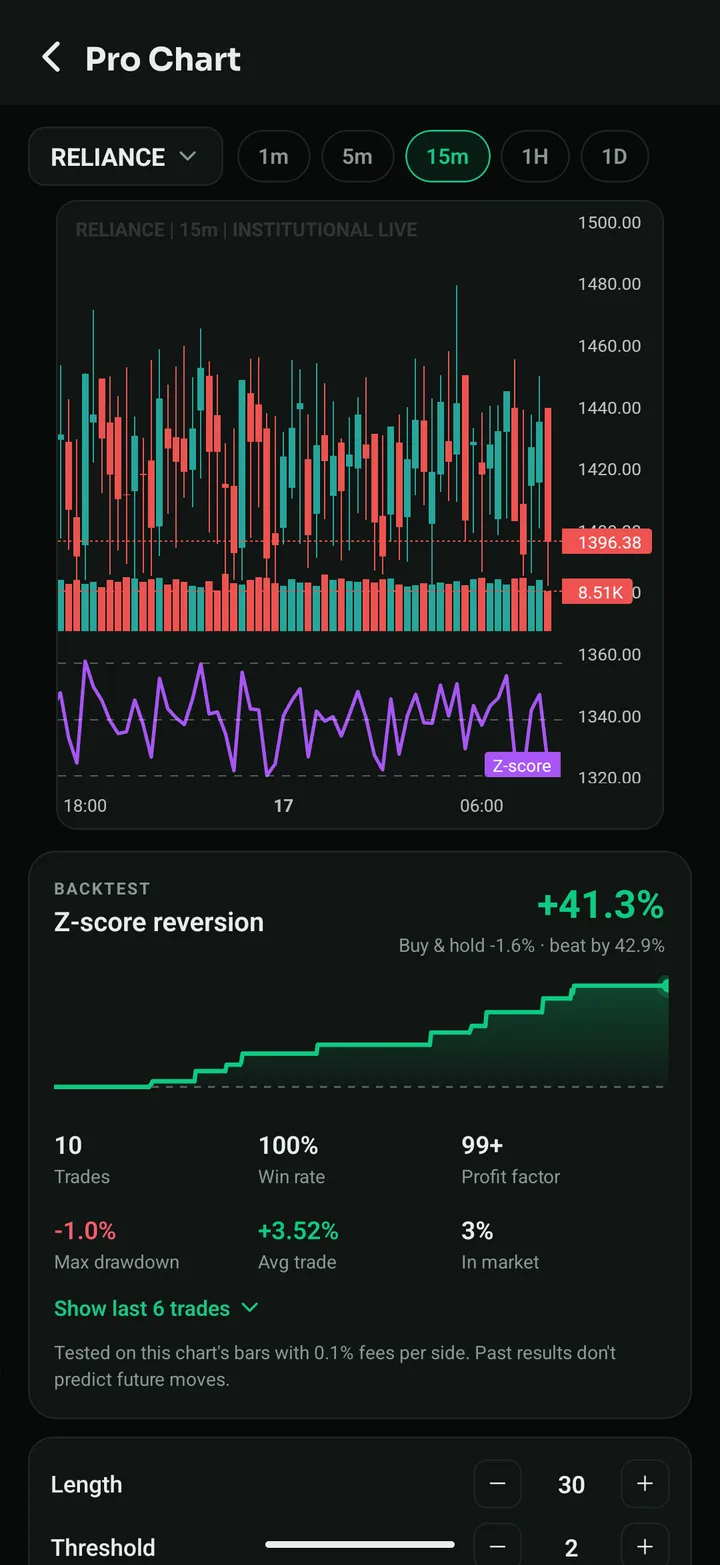
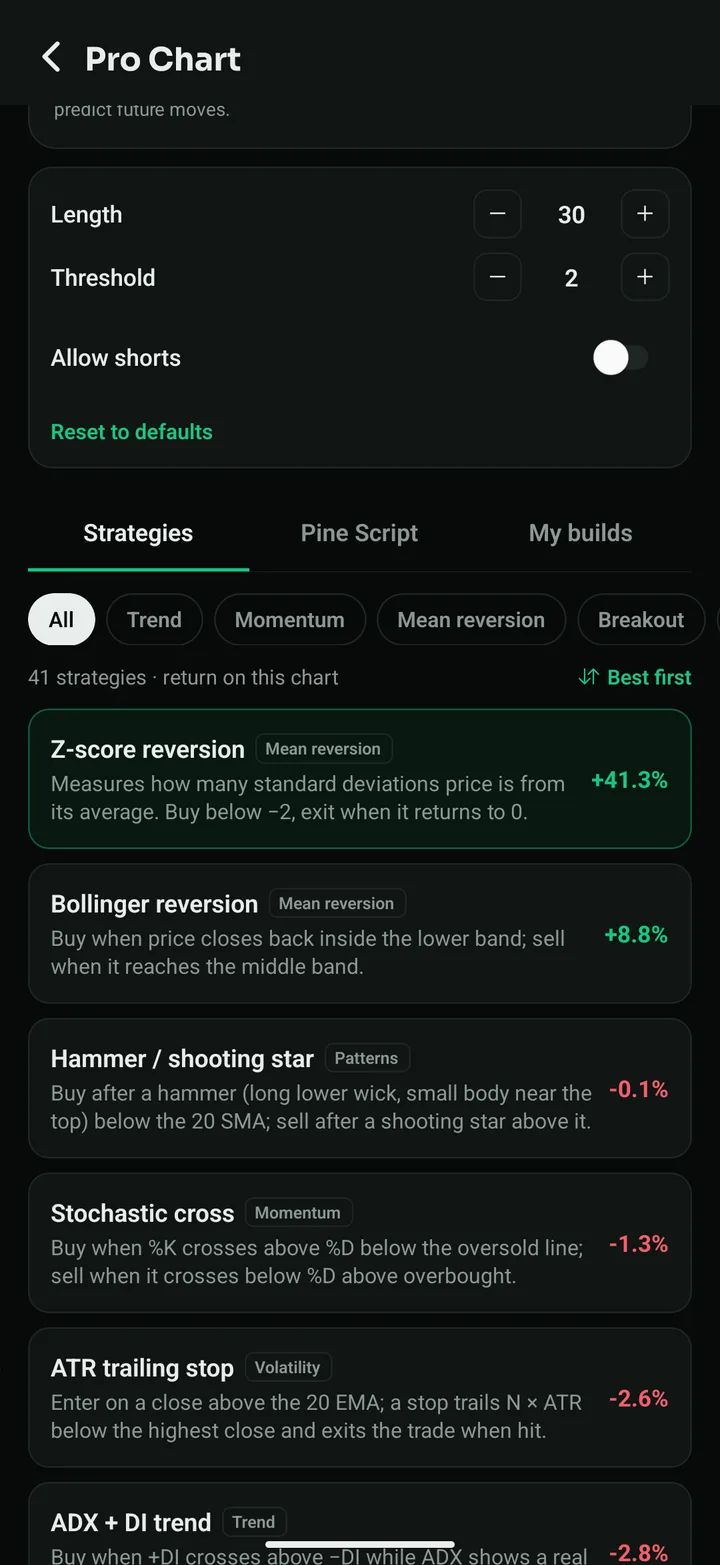
For learning, a white box beats a black box every time: you see each rule, each signal and each losing trade, so every result teaches you something. That is how Pro Chart in the StockYatra app is built. Each of its 41 strategies shows its rules and draws every buy and sell on the chart, and its backtest reports the bad numbers too: maximum drawdown, win rate, profit factor and return against buy and hold. You can also write your own rules without code or in Pine Script, and test them with virtual coins.
Key takeaways
- Black box = logic hidden; white box = rules visible and testable.
- All trading systems run data → features → model → signal → execution.
- Black boxes are good flashlights and dangerous pilots.
- Judge them by accountability, verified results and their worst numbers.
- Learn with white-box rules first so every result teaches you something.
Practise with rules you can see
StockYatra is a free practice app for Nepal (NEPSE), India (NSE) and US stocks. Test 41 transparent strategies, write your own rules or Pine Script, and backtest them on the chart with virtual coins. Nothing is hidden and nothing is real money.
The black box AI series
- SEBI rules: white box vs black box algos
- AI trading bot scams: 10 red flags
- Black box or white box: where beginners should start
- Can AI predict the stock market?
- Unusual volume, options flow and dark pools, explained
- Black box AI trading: the one-page guide
- Pro Chart: 41 strategies with every rule shown
StockYatra is an education app, not a broker, adviser or research analyst. Nothing here is a recommendation to buy or sell any security or to use any trading product. Rules and dates are summarised for learning; check the regulator's and your broker's current notices before acting. Practice prices are simulated and coins are virtual.