In short
- Algos win on discipline, speed, scale and testability.
- Humans win on context, adaptability and understanding.
- Algos fail silently when markets change; humans fail loudly when emotions take over.
- For most beginners the best start is a hybrid: written rules, executed by hand, tested first.
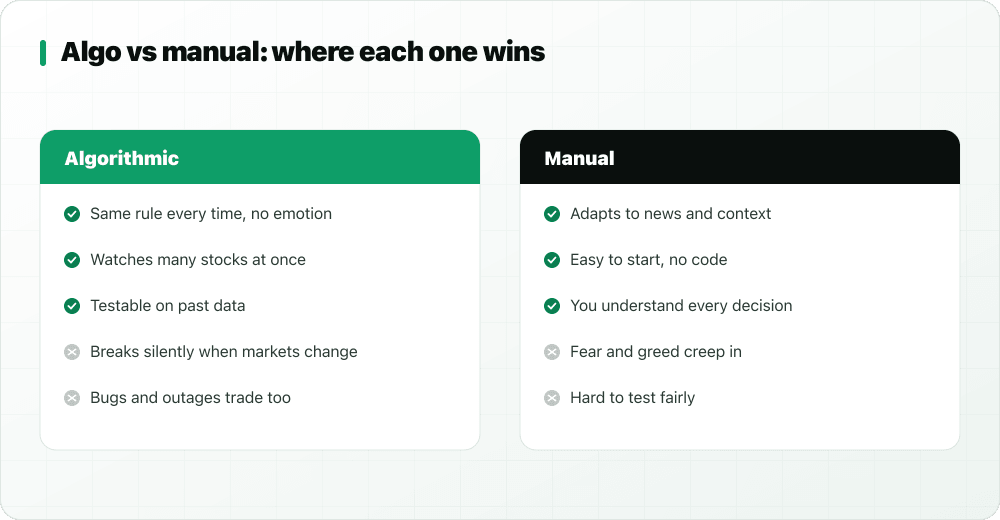
"Should I trade manually or use an algorithm?" is one of the most common questions new traders ask, especially as automated tools spread in India and the US. The honest answer is that each fixes some problems and creates others. Here is a fair comparison.
| Algorithmic | Manual | |
|---|---|---|
| Discipline | Follows rules every time | Fear and greed can override the plan |
| Speed and scale | Reacts instantly, watches many markets | Limited by attention and time |
| Testing | Can be backtested exactly | Hard to test fairly; memory is selective |
| Adapting to news | Only if it was programmed to | Can read context and step aside |
| Failure mode | Keeps trading when the market has changed; bugs trade too | Overtrading, revenge trades, freezing |
| Set-up | Needs rules, code or tools, and broker access where allowed | An account and a chart |
| Rules | Regulated differently by country (see India and Nepal guides) | Standard trading rules |
Where algorithms clearly help
- Consistency. The same signal gets the same response every time.
- Removing hesitation. Exits happen when the rule says, not when you feel ready.
- Honest records. Every trade is logged, so you can measure what works.
- Scale. Scanning hundreds of charts is easy for code.
Where humans still win
- Context. A merger rumour, a policy change, a holiday-thin market: people notice; simple algos do not.
- Knowing when to stop. A trader can see that conditions no longer suit the strategy.
- Understanding. If you made the decision, you know why, and you learn from it.
How each one fails
Algorithms fail quietly: a rule that worked in a trending year keeps firing in a choppy one, losing a little each time, and nobody notices until the drawdown is large. Speed can make it worse; on 6 May 2010, automated selling helped drive US stocks sharply down and back within minutes in the "Flash Crash". Humans fail loudly: one bad loss, then a bigger trade to win it back.
The hybrid most beginners should start with
- Write your strategy as rules, as if a computer had to follow them.
- Backtest those rules with costs and out-of-sample data.
- Execute by hand, but only when the rules say so, and log every trade.
- Review weekly: did you follow the rules? Did the rules work?
- Automate later, if at all, where your broker and regulator allow it.
This gives you the discipline of an algo and the understanding of manual trading, without the technical and regulatory risks of automation on day one. In Nepal, where retail automation is not permitted on TMS today, it is also the practical route; see algo trading in Nepal.
Practise both styles side by side
In StockYatra you can trade by hand on NEPSE, NSE and US practice charts with Market, Limit and Stop orders, and in Pro Chart see exactly where a strategy's rules would have bought and sold on the same chart. Compare your own trades with the rules' trades, using virtual coins, and the trade journal records your setup and mood for each trade so you can see where emotion crept in.
Key takeaways
- Algos bring discipline, speed and testability; humans bring context and judgement.
- Algos fail silently when markets change; humans fail through emotion.
- A hybrid (written rules, executed by hand) suits most beginners.
- Automate only after testing, and only where allowed.
Compare your trades with the rules'
StockYatra is a free practice app for Nepal (NEPSE), India (NSE) and US stocks. Test 41 transparent strategies, write rules without code or in Pine Script, and backtest them on the chart with virtual coins. Nothing connects to a broker and nothing is real money.
The algo trading series
- What is algorithmic trading?
- Algo trading in India: the 2026 rules
- Is algo trading allowed in Nepal?
- How to backtest a trading strategy
- Classic algo trading strategies, explained
- How to start algo trading as a beginner
- Algo trading: the one-page guide
- Black box AI trading, explained
- Pro Chart: 41 strategies with every rule shown
StockYatra is an education app, not a broker, adviser or research analyst. Nothing here is a recommendation to buy or sell any security, to use any trading product, or legal advice. Rules and dates are summarised for learning; check the regulator's and your broker's current notices before acting. Practice prices are simulated and coins are virtual.