StockYatra reached the App Store and Google Play in August 2026. By the end of September, 1,723 people had opened an account and 10,166 practice trades had been placed on the simulator. That is a small dataset by global standards, but it is the first one of its kind for Nepal: thousands of first-time investors, mostly Nepali, trading NEPSE, Indian and US names with nothing at stake. Here is what it shows.
In short
- 1,723 registered traders; 1,171 (68%) have placed at least one practice trade.
- Evenings rule: the busiest hours are 8–10 pm Nepal time, not market hours.
- 73% of trades are long, 27% short — beginners do try short selling when it is free to try.
- 31% of trades use leverage, and 5× is the most popular setting among those that do.
- Most people are still testing the water: 301 traders have placed exactly one trade; nine have placed more than 100.
Who is trading
Of 1,723 accounts, 1,171 have traded — a 68% activation rate, which is high for a finance app and tells us the first-trade flow (10,000 coins, no KYC, one tap to the NEPSE board) works. The rest signed up and stopped at the lessons, the chat, or the IPO tracker, which are also fine reasons to be here.
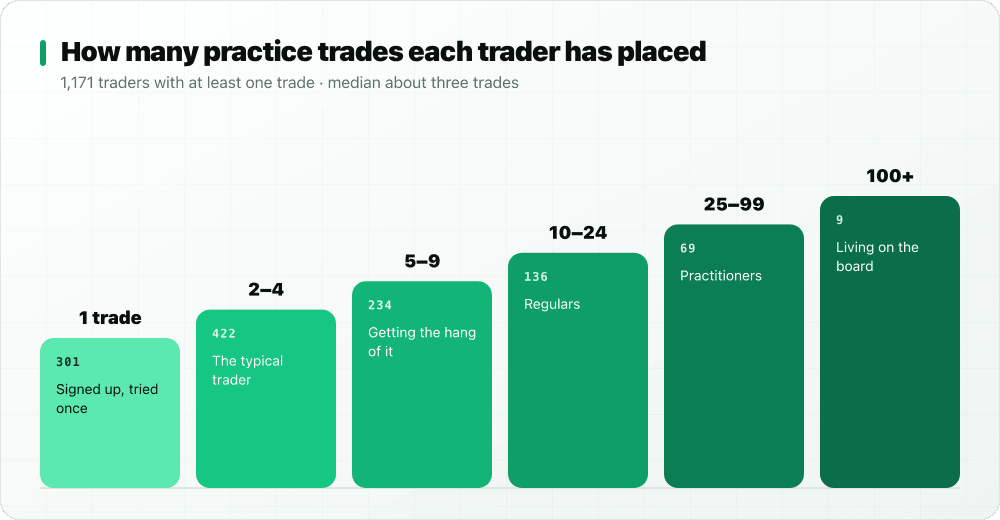
The distribution is a long tail. 301 traders placed exactly one trade. 422 placed two to four. 234 placed five to nine. From there it thins out — 136 traders in the 10–24 range, 49 in the 25–49 range, 20 in the 50–99 range, and nine traders with more than 100 trades. Those nine are already behaving like practitioners: sizing positions, using stop-losses, closing losers.
When Nepal trades: evenings, not market hours
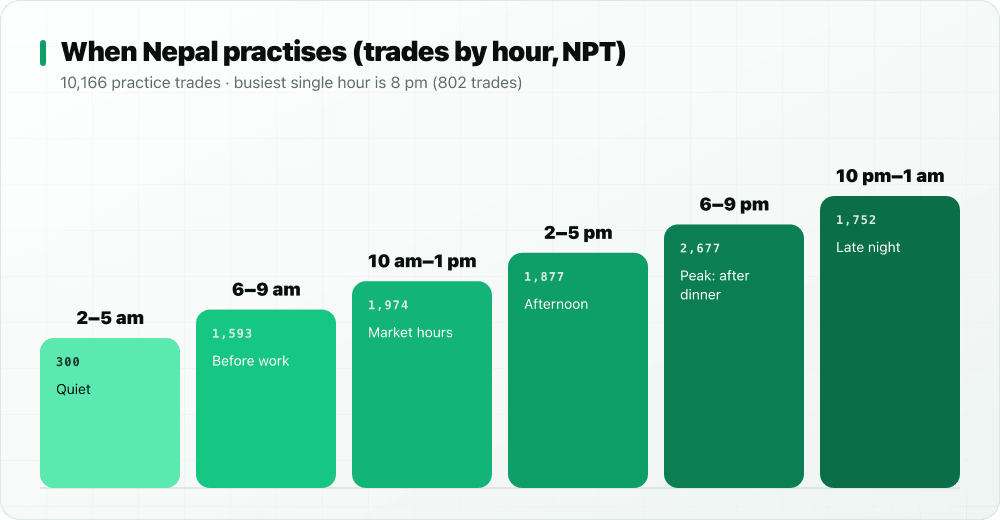
NEPSE is open 11:00–15:00, Sunday to Thursday. Our users mostly practise after dinner. The busiest hours are 8 pm (802 trades), 9 pm (771) and 10 pm (682) Nepal time. There is a second, smaller peak at 8–10 am before work. The quietest window is 2–5 am. Because the practice market runs round the clock, a student in Pokhara and a worker in Doha can both trade when they actually have time — and the data says that is exactly what they do.
Long, short and leverage
7,475 trades (73%) were long and 2,698 (27%) were short. Short selling is not available to retail investors on NEPSE, so this is the only place many of these traders will ever practise it — and a quarter of them do. Leverage tells a similar story: 7,002 trades used none, but 3,171 (31%) used some, and among those the most popular setting was 5× (1,672 trades), followed by 2× (999). We think that is healthy: the point of a simulator is to find out what 5× feels like on a red day without paying for the lesson.
Which markets
StockYatra opened with NEPSE only and added India and US stocks later, so Nepal dominates: roughly 86% of all trades are in NEPSE names. Of the trades since the other boards opened, US stocks (837, led by AAPL) are more popular than Indian stocks (423, led by RELIANCE). Our reading: Nepali traders are curious about Apple and Nvidia, but the home market is where they want to get good. The full breakdown is in the most-traded NEPSE stocks.
Beyond trades
The simulator is not the only thing people use. The verified-only Global chat has passed 1,297 messages, and traders have sent 1,118 friend requests inside the app, of which 383 are accepted friendships so far. On 28 September, 1,014 people opened StockYatra in a single day. For a two-month-old app from Kathmandu, that is the number we are proudest of.
Key takeaways
- Two months in: 1,723 traders, 10,166 practice trades, 1,014 daily actives at peak.
- Nepal practises in the evening. A 24-hour practice market matters more than we expected.
- A quarter of trades are shorts and a third use leverage — things you can only learn safely on paper.
- The next job is retention: turning one-trade sign-ups into thirty-trade learners.
Method: counts are from StockYatra's production database on 29 September 2026. "Traders" are registered accounts; "practice trades" are orders placed in the simulator. All trades are paper — virtual coins, no real money. Nothing here is a recommendation to buy or sell anything.
Start practising free on StockYatra
Download StockYatra on iPhone or Android, or open it in the browser, start with 10,000 free virtual coins, and practise live-simulated Nepal, India and US stocks. No card, no demat, no KYC. Coins are virtual and no real money is ever at risk.