By 29 September 2026, StockYatra users had closed 9,263 practice trades. 6,685 of them — 72% — closed with a profit. If a friend told you they win 72% of their trades, you would either not believe them or hand them your savings. Please do neither. This article is about why a simulator produces that number, what it hides, and how to practise so your habits survive contact with real money.
In short
- 72% of closed practice trades on StockYatra were profitable. Professional traders are often happy with 40–55%.
- Simulators remove fees, slippage, fear and consequences — the four things that produce most real-world losses.
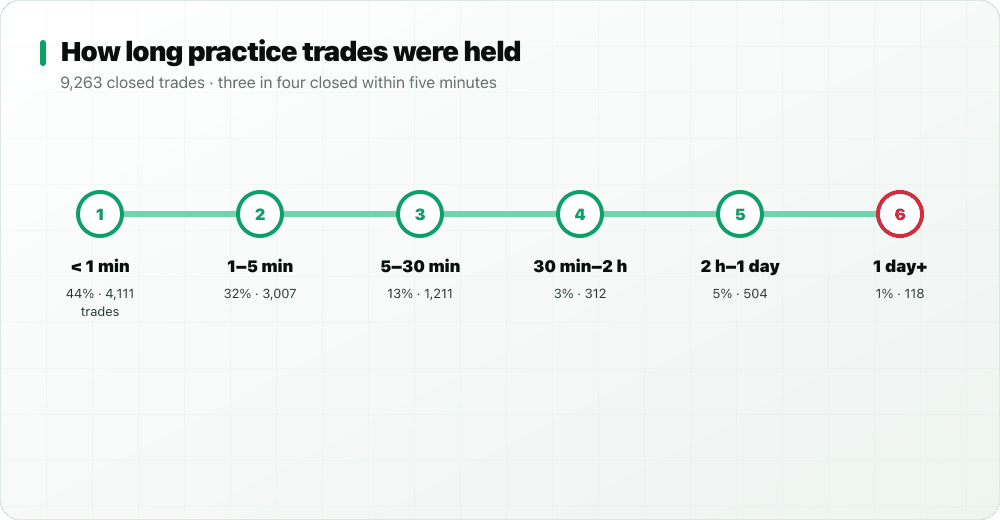
- 44% of our trades were closed within one minute, and 76% within five. That is scalping on a fee-free engine, not investing.
- Practise like it is real: position size, stop-loss, a journal, and holding through a red day.
Where the 72% comes from
Four things are missing from any simulator, including ours, and every one of them pushes the win rate up.
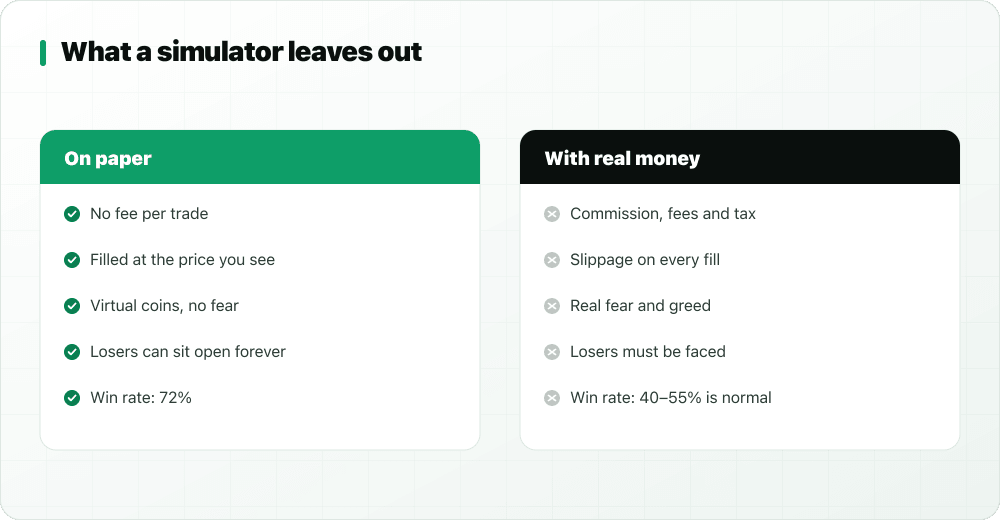
- No fees. StockYatra charges nothing per trade — that is a promise. A real NEPSE broker charges commission, SEBON fee, DP charge and capital-gains tax. A scalp that nets +0.4% on paper is a loss after costs.
- No slippage. On paper you buy at the price you see. In a real order book, especially on a thin NEPSE name, you buy higher and sell lower than you meant to.
- No fear. Watching 10,000 virtual coins fall 8% is a lesson. Watching Rs. 1,00,000 of your salary fall 8% is a different chemical event. Most bad real-money decisions happen in that state, and a simulator cannot produce it.
- No consequences for the losers you never close. Paper traders let losing positions sit and take profits on winners — so closed trades look great while open ones rot. Real traders eventually have to face the open losers.
The holding-period problem
Our data makes the point sharply. Of 9,263 closed trades, 4,111 (44%) were closed within one minute of opening. Another 3,007 (32%) were closed within five minutes. Only 622 trades — 7% — were held longer than two hours, and 118 (1.3%) were held for more than a day. On an engine that ticks every half-second and charges nothing, closing a trade the moment it flickers green is a winning "strategy". In the real market it is a way to pay your broker with your own money.
Leverage makes it worse
31% of trades used leverage, and the most popular setting was 5×. On paper, 5× turns a 2% move into a 10% win and a 2% dip into a 10% loss that you can shrug off. With real money, a 10% loss on a leveraged position is where people stop trading for good. We keep leverage in the simulator precisely so you can feel that swing where it is free — but the feeling is the lesson, not the win.
How to practise so it transfers
- Size positions like it is real. Never put more than 5–10% of your coins in one trade. Our position-size calculator does the maths.
- Set a stop-loss before you enter. Every trade. If you cannot say where you are wrong, you are not trading, you are hoping.
- Hold through a red day. Open a trade, set the stop and the target, and do not touch it for at least one session. That is the muscle a real account needs.
- Charge yourself fees. Mentally deduct 1% per round trip. If a trade is not worth 1%, it was not worth taking.
- Keep a journal. Why you entered, why you exited, how you felt. Our trading journal guide shows the format.
- Close your losers. Your win rate should fall. That is the number becoming honest.
Key takeaways
- 72% is a simulator artefact, not a skill. Expect 40–55% with real money, and plan for it.
- Fees, slippage, fear and unclosed losers are what the real market adds. Practise as if they existed.
- Three in four practice trades were closed within five minutes; the goal is to hold, not to flicker.
- The job of paper trading is to build habits — sizing, stops, journaling — not to post a win rate.
Method: counts are from StockYatra's production database on 29 September 2026. "Traders" are registered accounts; "practice trades" are orders placed in the simulator. All trades are paper — virtual coins, no real money. Nothing here is a recommendation to buy or sell anything.
Practise the habits, not the win rate
Download StockYatra on iPhone or Android, or open it in the browser, start with 10,000 free virtual coins, and practise live-simulated Nepal, India and US stocks. No card, no demat, no KYC. Coins are virtual and no real money is ever at risk.