Most people learn trading alone. They watch videos, read a few articles, open a practice account and try things. Some improve; many stall and never quite know why. One of the biggest differences between the two groups is not intelligence or screen time. It is whether they have other people around them who make them explain, reflect and stay consistent.
In short
- Communities create accountability: you show up more when someone notices.
- Explaining your reasoning out loud exposes gaps you cannot see in your own head.
- Seeing different trading styles breaks the "one right way" trap.
- Shared journaling and feedback turn random practice into deliberate practice.
- Avoid the traps: herd thinking, tip-chasing and copying trades you do not understand.
The lonely learner problem
Trading gives feedback that is noisy and delayed. A good decision can lose money; a bad one can get lucky. Alone, it is very hard to tell which is which, so beginners often learn the wrong lesson from a single result. They blame the market for losses and credit their skill for wins. Over time that bias quietly compounds, the way common beginner mistakes do.
Other people are the fastest correction for that bias. Not because they are always right, but because they ask questions you would not ask yourself.
1. Accountability: you show up when someone notices
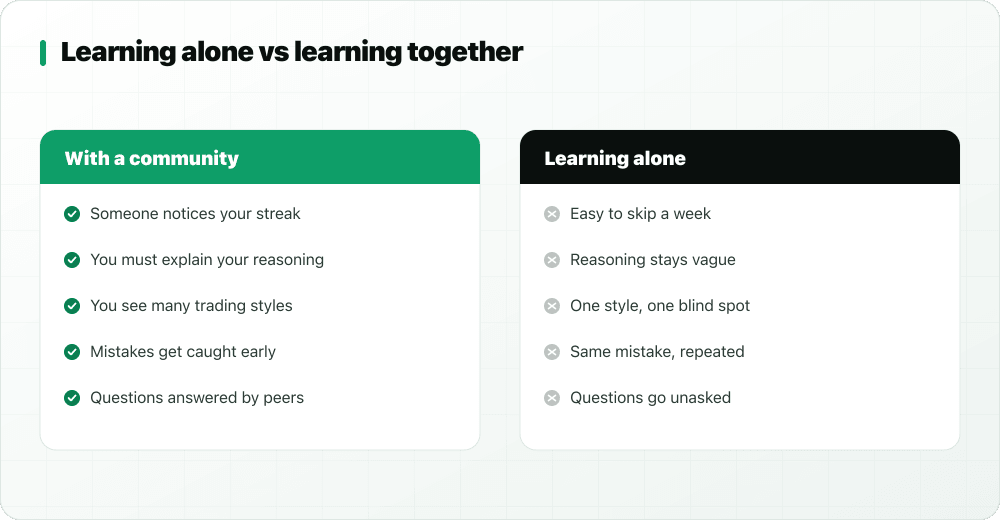
Skill in trading comes from repetition: many small, reviewed trades rather than a few big, emotional ones. The hardest part is simply continuing. A study partner who asks "did you do your review this week?" or a community where your streak is visible makes the habit stick. It is the same reason people keep going to the gym when they have a training partner.
On StockYatra, your learning streak and level are visible on your profile and in the Yatra Users directory, and friends can see when you are online. None of that forces you to practise, but it makes consistency something other people notice.
2. Explaining your reasoning exposes the gaps
There is a well-known effect in learning: explaining something to another person deepens your own understanding, and reveals where your understanding is thin. If you cannot explain in two sentences why you entered a trade, where your stop is and why, you probably did not have a plan. You had a feeling.
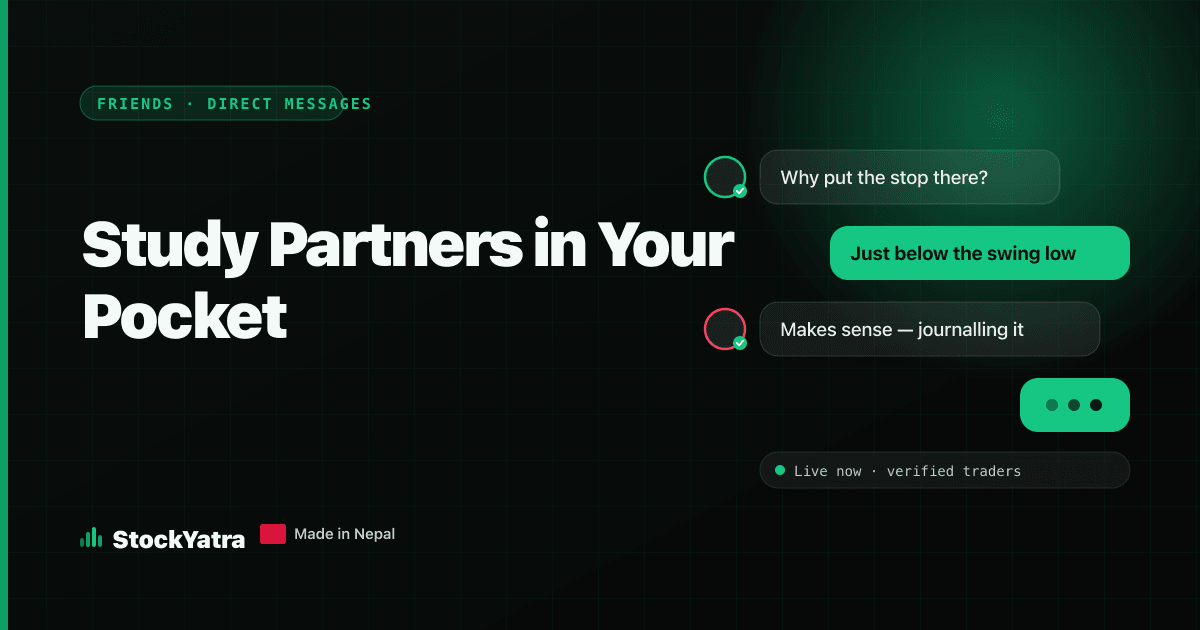
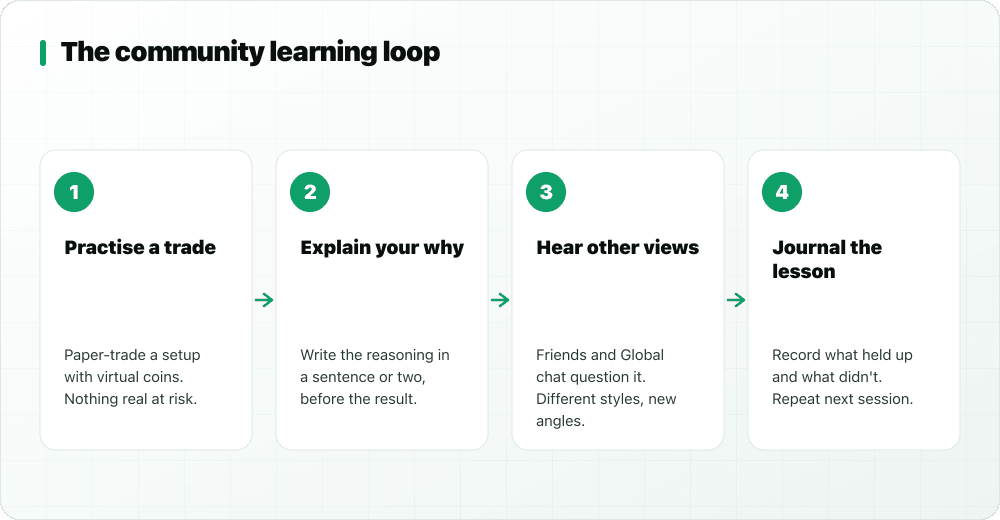
A simple exercise: before each practice trade, write down the why in one or two sentences, then share it with a friend or in Global chat. You will quickly find that some trades do not survive being written down. That is a trade you just saved yourself from.
3. Different styles break the "one right way" trap
Beginners often lock onto the first method they learn and assume everyone else is doing it wrong. A community shows you, quickly, that traders make money and lose money with very different approaches:
- Day traders open and close positions within a session and care about intraday levels.
- Swing traders hold for days or weeks, focusing on trends and pullbacks.
- Long-term investors think in years and focus on the business behind the share; see fundamental vs technical analysis.
Hearing how each of them thinks about the same chart teaches you what questions matter for your timeframe, and helps you choose a style that fits your temperament instead of copying someone else's.
4. Journaling gets better with an audience
A trading journal is the single most useful tool for improving, and the one most people abandon. Sharing even one journal entry a week with a study partner changes that. You write more carefully when someone will read it, and they will spot patterns you cannot: "you always exit winners early on Fridays" or "your losses are twice the size of your wins".
Learning alone vs learning together
The traps: when a community makes you worse
Not every group helps. Some make learners worse, fast. Watch for these:
Herd thinking
If everyone in a room is excited about the same idea, that is a reason for more caution, not less. Use the community to test your reasoning, not to borrow conviction. Our guide to trading psychology covers fear of missing out in detail.
Tip-chasing
Groups built around "calls" teach you to follow, not to think, and many are fronts for pump-and-dump schemes. That is why StockYatra's Global chat bans buy/sell tips outright. Learn to spot the pattern in how to spot stock-tip scams.
Copying trades you do not understand
Even a successful trader's trade is useless to you if you do not know why they took it, where they would exit, or how much of their account it risks. Ask about process; never just copy the position.
Confusing results with skill
A trader at the top of a leaderboard might be skilled, or might have had a lucky streak with outsized positions. Look at consistency, risk management and how they explain losses, not just the headline number.
How to give feedback that actually helps
A community is only as useful as the feedback people give each other. If you want good feedback, practise giving it:
- Ask before you tell. "What made you enter there?" teaches more than "you entered too early".
- Focus on process, not outcome. A losing trade that followed a sound plan is a good trade; a winning trade that ignored the plan is a warning.
- Be specific. "Your stop was inside the normal daily range" is useful; "bad trade" is not.
- One point at a time. Pick the single most important observation. Nobody fixes five habits in a week.
- Be kind. Everyone in a learning community is, by definition, still learning, including you.
What to look for in a trading community
Before you invest your time in any group, online or offline, check for these:
- Clear rules against tips and hype. A community that allows "sure-shot calls" is a tip group, whatever it calls itself.
- Real, accountable members. Verification or some other barrier against throwaway accounts.
- Active moderation. Someone removes abuse and spam, and there is a way to report problems.
- Nobody asks for money. No paid "premium signals", no account-handling offers, no requests for logins.
- Reasoning is valued. The most respected members explain their thinking and talk openly about their losses.
A simple weekly routine
| When | What to do | Time |
|---|---|---|
| Before each trade | Write your entry, stop-loss, target and one-line reason | 2 min |
| Daily | Read Global chat; answer one question you know, ask one you don't | 10 min |
| Twice a week | Journal your closed practice trades honestly | 15 min |
| Weekly | Review one win and one loss with a study partner by DM | 20 min |
| Monthly | Pick one habit to change based on what your partner noticed | 15 min |
Where StockYatra fits in
StockYatra was built to make this routine easy and free. You practise on live-simulated NEPSE-style prices with 10,000 free virtual coins, so mistakes cost a lesson rather than your savings (see paper trading vs real trading). The community features add the other half: Global chat for questions, friends and DMs for trade reviews, and Yatra Users to find people at your level. Everything uses virtual coins, and nobody on StockYatra gives buy or sell advice.
Key takeaways
- Accountability keeps you practising; visible streaks and study partners help.
- Explaining a trade in writing is the fastest test of whether you had a plan.
- Exposure to different styles helps you choose your own instead of copying.
- Avoid herd thinking, tip groups and copying trades you do not understand.
Start learning with others, free
Download StockYatra on iPhone or Android, start with 10,000 free virtual coins, and practise live-simulated NEPSE-style markets alongside other learners. No real money is ever at risk.