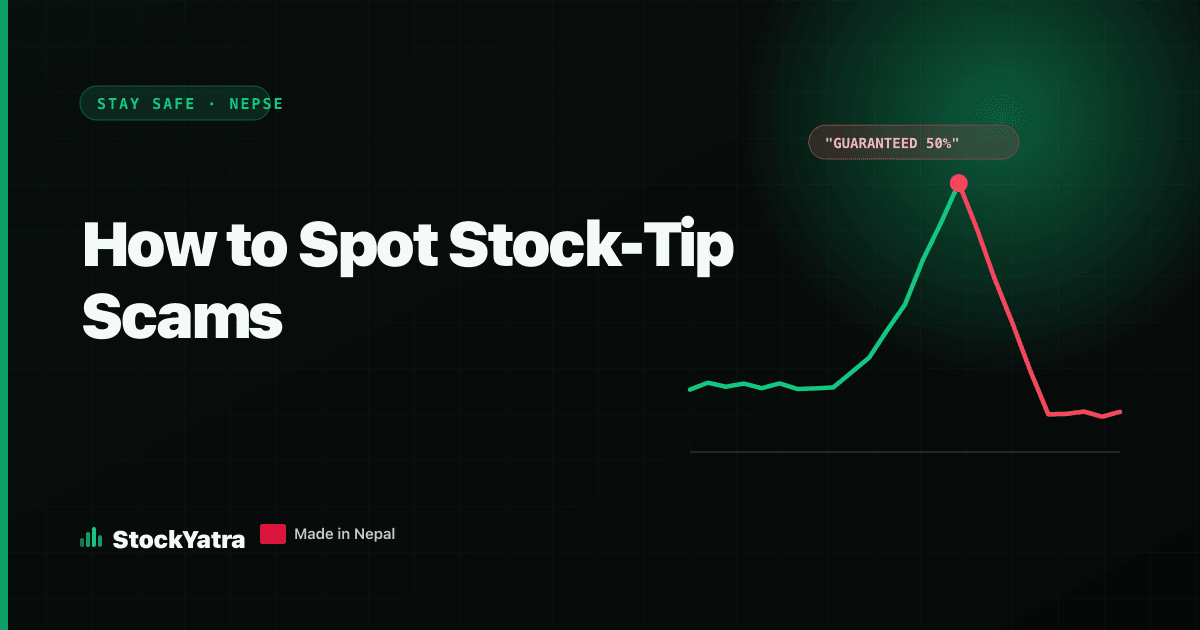
Every time the share market gets busy in Nepal, new investors arrive, and so do people ready to take their money. The approach is almost always the same: a Telegram or WhatsApp group, a confident "analyst", screenshots of huge profits, and a promise of guaranteed returns. This guide shows you how these stock-tip scams work, the red flags to watch for, and how to protect yourself and your friends.
In short
- No one can guarantee stock market returns. A "guaranteed" or "fixed" return is the biggest red flag there is.
- Paid tip groups, unverifiable profit screenshots and pressure to act now are classic scam tactics.
- In a pump-and-dump, organisers hype a thinly traded share, then sell to the people they convinced to buy.
- Never share your broker (TMS) login, Meroshare details, OTP or PIN. Report scams and walk away.
Why tip scams target new investors
New investors are the ideal target: eager to grow their savings, unsure how the market works, and often learning from social media. After an IPO allotment or a strong run in NEPSE, many people open Demat accounts for the first time (see what is a Demat account). They want someone to tell them what to do next. Scammers are happy to fill that gap.
The platforms change, from Facebook pages to Telegram channels to WhatsApp groups, but the playbook stays the same.
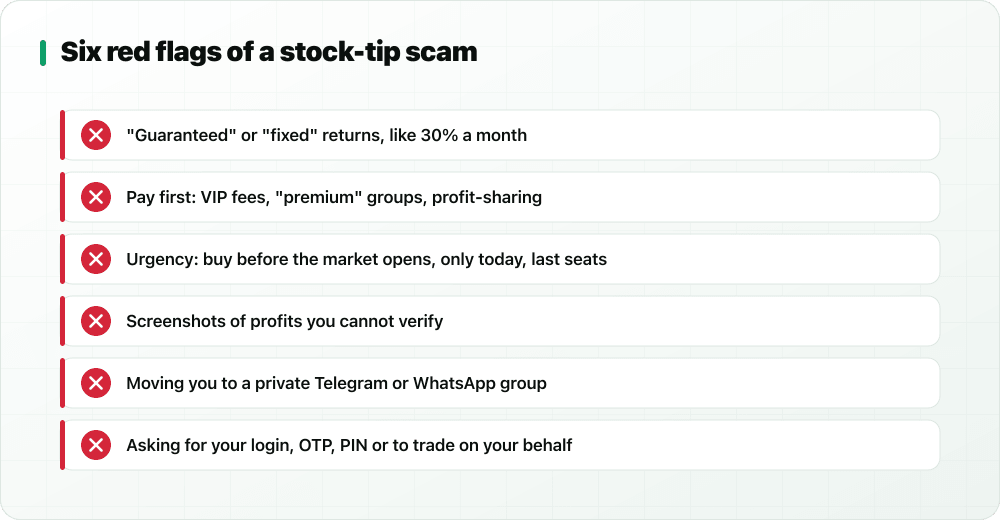
Six red flags of a stock-tip scam
1. "Guaranteed" or "fixed" returns
Share prices go up and down. Nobody, not a broker, not a fund manager, not an "expert" on Telegram, can guarantee a return from shares. Anyone who promises "30% a month" or "double your money by Dashain" is either mistaken or lying.
2. Pay first: VIP fees and "premium" groups
The free group gives a few vague calls; the "real" tips are in a paid VIP group. Sometimes it is a profit-sharing deal: "pay us 20% of what you make". Ask yourself: if their tips reliably made money, why would they need yours?
3. Urgency
"Buy before the market opens." "Only five seats left." "Offer ends tonight." Urgency is designed to stop you from thinking, checking or asking anyone. Genuine opportunities survive a day of research.
4. Profit screenshots you cannot verify
A screenshot of a portfolio in profit is easy to edit or cherry-pick. You never see the losses, the accounts that were wiped out, or whether the screenshot is real at all.
5. Moving you to private groups
Scammers like to pull people off public pages into private Telegram or WhatsApp groups, where critics can be removed quietly and nothing is visible to outsiders.
6. Asking for your login, OTP or PIN
Some schemes offer to "manage your account" or "place trades for you". That means handing over your broker (TMS) login, Meroshare credentials or OTP. No legitimate adviser needs these. Once someone has them, they control your account.
How a pump-and-dump works
The pump-and-dump is the classic tip-group scheme. It usually targets a share that is thinly traded, where a relatively small amount of buying can move the price a lot.
- Accumulate quietly. The organisers buy the share cheaply while nobody is paying attention.
- Pump. Their groups fill with excited messages: "big news coming", "target 50%", "last chance". Members start buying and the price climbs.
- Dump. Into that buying, the organisers sell the shares they bought earlier, at a large profit.
- Crash. With the hype gone and the organisers out, buying dries up. The price falls, often below where it started, and late buyers are left holding losses.
The people who join the group last, usually beginners, are the ones who pay. Understanding how prices move and why risk management matters helps you see why a sudden spike on no real news deserves suspicion, not excitement.
Other common scams to know
- Fake apps and websites that look like trading platforms and show fake profits, then refuse withdrawals or demand "tax" to release your money.
- Impersonation of brokers, companies or well-known market commentators on social media.
- IPO "allotment guarantees" that promise shares in an oversubscribed IPO for a fee. Allotment follows the official process; nobody can sell you a guarantee. Our IPO guide explains how allotment works.
- Account-handling deals where someone trades your real account for a share of profits, and leaves you with the losses.
Got a hot tip? Run this check
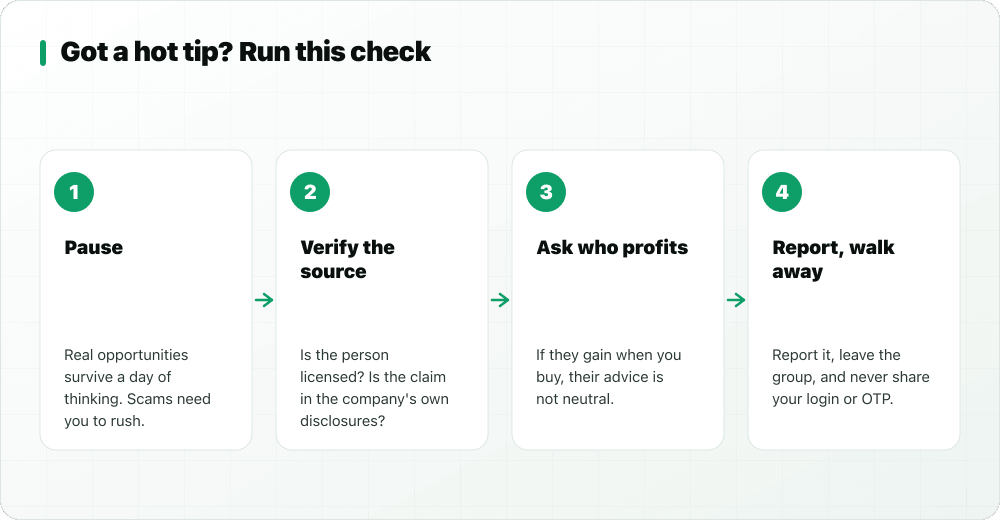
- Pause. Do nothing for 24 hours. If the "opportunity" disappears, it was pressure, not opportunity.
- Verify the source. Is the person or firm licensed by SEBON (the Securities Board of Nepal) for the service they claim to offer? Is the "news" in the company's own official disclosures?
- Ask who profits. If the tipper benefits when you buy, because they hold the share or charge a fee, their advice is not neutral.
- Report and walk away. Leave the group, block the account, and report it.
If you have already been targeted
- Stop paying. Do not send more money to "unlock" profits or cover "fees" and "taxes". That is a second stage of the same scam.
- Secure your accounts. If you shared any login, password, OTP or PIN, change your passwords immediately and contact your broker and bank.
- Keep evidence. Save screenshots of chats, payment receipts, phone numbers and group names.
- Report it. Tell your broker, report to SEBON, and file a complaint with Nepal Police's Cyber Bureau for online fraud.
- Warn others. Tell friends and family, especially anyone who joined the same group.
How StockYatra's community is designed against tip scams
When we built chat into StockYatra, we designed it so that tip groups cannot take root there. Here is how it compares with a typical paid tip group:
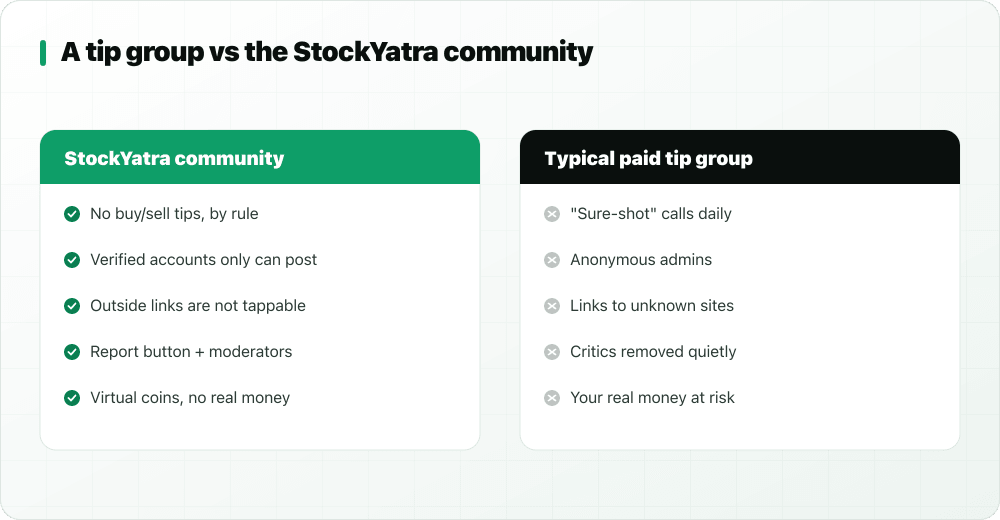
- No tips, by rule. The Global chat guidelines ban buy/sell tips, "sure-shot" calls and pump talk.
- Verified accounts only can post. Posting, friends and DMs need a verified email or phone, which keeps out throwaway accounts.
- Outside links are not tappable. Only StockYatra-family links become clickable, so nobody can drop a link to a VIP group or fake app.
- Friends-only DMs. Strangers cannot message you privately with an "offer".
- Reporting and moderators. Anyone can report a message; moderators can remove it, mute or ban the sender.
- Virtual coins only. StockYatra is paper trading. Nobody in the app can take your real money.
Read more about how Global chat works in Global chat for Nepali traders.
Build immunity by practising first
The best defence against tip scams is understanding. When you have placed a few hundred practice trades, set your own stop-losses and watched how prices really behave, "guaranteed 50%" sounds as ridiculous as it is. Paper trading gives you that experience with virtual coins, on live-simulated prices, with no real money at risk. You can also learn the basics in our FAQ and stock market basics.
Key takeaways
- Guaranteed returns do not exist in the stock market; treat any promise of one as a scam.
- Watch for pay-first VIP groups, urgency, unverifiable screenshots, private groups and requests for logins or OTPs.
- Pump-and-dump organisers profit by selling into the hype they create; late buyers lose.
- Pause, verify, ask who profits, then report. StockYatra's community bans tips and blocks outside links by design.
Practise safely, with zero real money
Download StockYatra on iPhone or Android, start with 10,000 free virtual coins, and practise live-simulated NEPSE-style markets alongside other learners. No real money is ever at risk.